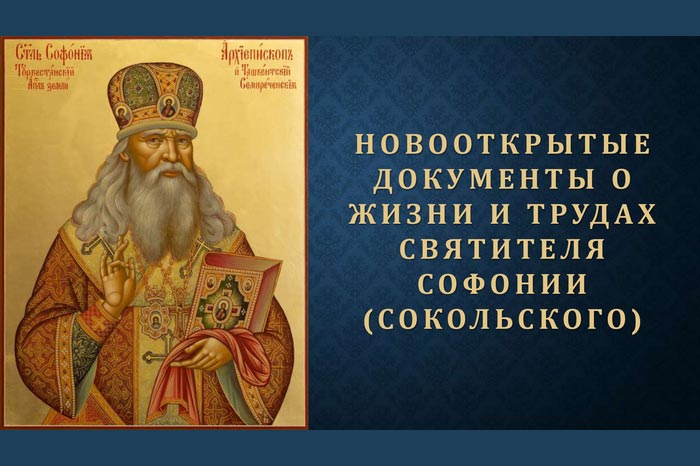
Address of Metropolitan Alexander of Astana and Kazakhstan, Head of the Orthodox Church of Kazakhstan, at the International Academic Conference “Sofony Readings”: “Newly discovered documents on the life and work of Saint Sofony (Sokolsky)”.
Your Graces, most reverend hierarchs,
venerable fathers, brothers and sisters,
I cordially greet the participants of the International Academic Conference – the Almaty Orthodox Educational Readings in memory of Saint Sofony, the first archpastor of the land of Kazakhstan.
Our annual meeting, held by the Almaty Diocese together with the Almaty Orthodox Theological Seminary, is taking place for the twenty-third time. Today’s event is dedicated to a special date – the 225th anniversary of the birth of an outstanding hierarch of the nineteenth century, an ascetic of piety, Archbishop Sofony (Sokolsky) of Turkestan, whom we rightfully call the apostle of the Great Steppe.
Although much has been said this year about the life and labours of this worthy archpastor, many of the materials obtained in the course of the ongoing collection of documents for his canonisation still remain the property of a narrow circle of researchers who study archival sources. Therefore, in this jubilee year it seems appropriate to say a few words about newly established facts of his biography and about autographs of the Turkestan saint that are as yet unknown to the wider audience.
We should begin with the fact that only last year, on the basis of the registry entry of his birth, the exact date of the birth of Saint Sofony was established as 25 July 1800. Previously it had been thought that he was born on 26 November 1799. This is important for the affirmation of historical accuracy. From the same point of view, the service records found for him for the years 1848, 1855, 1863 and 1872 are also significant. These lists of his obediences and merits give not only the precise dates of the different stages of the life’s path of the ever-memorable hierarch, but also reveal events previously hidden from researchers.
Thus, for example, it has become known that, while inspector of the Arkhangelsk Theological Seminary, he repeatedly, in 1834, brought several merchants who were in mutual enmity to reconciliation in church. This peacemaking aspect of the activity of Saint Sofony is only now being opened to us.
From the service records it also becomes quite evident that, despite his appointment as rector of the Yaroslavl Seminary in 1844, he did not arrive at the place of his service until April 1845, remaining meanwhile on duty at the St Petersburg Diocesan Consistory. This circumstance makes it possible for us confidently to affirm that the well-known letter of Saint Ignatius (Brianchaninov), written to Saint Sofony in the winter of 1845, was undoubtedly received and read by its addressee, about which there had previously been some doubts.
Among the new data about the life and work of Saint Sofony we should also mention the discovery of documents about his inspection of the Kostroma Diocese in 1845 and of the Pskov Diocese in 1854. This latter fact enables us to form a clearer understanding of the character of Archimandrite Sofony’s activity between his labours in Constantinople and in Rome.
We now also have at our disposal a copy of the petition of Hieromonk Sofony (Sokolsky), inspector of the Arkhangelsk Seminary, submitted in 1834, requesting to be released from service in the seminary and transferred to a monastery. The petition was not granted, but the dream of monastic seclusion did not leave him either on Mount Athos or in Turkestan.
Another newly discovered autograph substantially transforms our understanding of the stature of the future Turkestan saint. We are speaking of a text of 104 pages prepared by Archimandrite Sofony in 1837, while serving as rector of the Oryol Seminary, and entitled “Synopsis of Seminary Instruction in the Theological Disciplines”.
The background of this text is as follows: in 1837 a “Committee for the Revision of Textbooks in the Field of Theology” was established at the St Petersburg Theological Academy, which instructed the rectors of the seminaries to send synopses of the theological subjects taught by them. The text of Saint Sofony is one of the most extensive and is written partly in Latin. Careful study of the “synopsis” shows that the terminology employed in it has its origin in the theological system of the outstanding preacher and educator Saint Innocent (Borisov), Archbishop of Kherson and Taurida, whom Saint Sofony knew from their common years in the theological academy.
We have also discovered an anonymous reviewer’s report on the “synopsis” of Archimandrite Sofony. The text of this document shows that the reviewer was unfamiliar with the theological terminology of Saint Innocent and did not understand the systematic intention of the rector of the Oryol Seminary. At the same time, however, the reviewer highly appreciated the author’s proposals regarding the organisation of the very process of teaching seminarians. In the “synopsis” Saint Sofony wrote the following: “The success of any undertaking, and all the more of learning, depends upon the freedom of the spirit and upon love for the subject…”. This idea, which is not entirely typical for its time, undoubtedly has as its source the way of thinking of Saint Innocent (Borisov).
The particular reverence of Saint Sofony for Saint Innocent is vividly borne witness to by their correspondence. Part of the letters of Archimandrite Sofony from Constantinople to Bishop Innocent in Odessa was published at the beginning of the twentieth century, but we have been able to find several more letters which had hitherto been unknown. In one of them Archimandrite Sofony writes with spiritual foresight that the Kherson archpastor will be glorified by the Lord among the saints.
Another recently found letter, belonging to the Constantinople period of the ministry of Saint Sofony, is addressed to the poet and statesman Prince Pyotr Alexeyevich Vyazemsky, a friend of Alexander Sergeyevich Pushkin. Prince Vyazemsky was at that time, in 1850–1851, travelling in the East, where the hierarch laboured. The letter to him from Saint Sofony is full of words of support and consolation. The saint sought to comfort the grieving and ailing prince, who had buried almost all of his children.
Important also is the discovery of letters from Saint Sofony to the first head of the Russian Ecclesiastical Mission in Jerusalem, Archimandrite Porphyrius (Uspensky), who was one of his closest friends since their studies at the theological academy. It was precisely Father Porphyrius who persuaded Archimandrite Sofony to submit a petition for appointment to Istanbul in 1947, and, as has now become clear, it was he who advised Father Sofony to request appointment as rector of the church of the Russian embassy in Rome. We may with confidence say that it was under the influence of Archimandrite Porphyrius that Saint Sofony became an orientalist and a profound specialist in the liturgics of the Eastern Churches.
The study of the period of the ministry of Saint Sofony in Rome has also been marked by new findings. Annual reports drawn up by him have been found. A copy of the parish register for several years of the ministry of Saint Sofony in the embassy church was sent from Rome. From this document we learn about his parishioners and about his spiritual care for members of the Russian Imperial House, ancient noble families and well-known Russian artists who lived in the Eternal City in the second half of the 1850s.
Documents have also been found which confirm that after his dismissal from Rome he underwent medical treatment in Germany and for several months was a cleric of the Russian embassy church in Vienna, from where he was sent to the Assyrian Nestorians in Transcaucasia as a recognised specialist in the Eastern Christian Churches.
Among the most important discoveries are likewise the episcopal consecration charter of Saint Sofony dated 1863, the Synodal decree bearing the personal signature of the Emperor on his elevation to the rank of archbishop in 1877, and the decree establishing at the St Petersburg Theological Academy a monetary prize in the name of Saint Sofony for successful students.
These newly discovered documents concern also his ministry in Turkestan. Particularly noteworthy are the recently found private letters describing life in the Turkestan Diocese and in the city of Verny, the hardships of his ministry and the resolution of numerous problems. Such letters Saint Sofony, with friendly warmth, addressed to his fellow-student at the academy, the Nizhny Novgorod Schema-Bishop Jeremiah (Solovyov).
The most recent in time, though by no means in importance, document fully copied by us is the inventory of items remaining after the blessed repose of Saint Sofony. In the inventory there is a rather modest wardrobe for an archpastor, small household items, several cassocks and undercassocks, inexpensive warm outer clothing. The most valuable items were those which, according to tradition, after the repose of hierarchs were returned to St Petersburg. In the case of Saint Sofony these were the Order of Saint Anna, First Class with diamonds, the Order of Saint Prince Vladimir, Third Class, and the Master’s Cross. The panagias listed in the inventory are simple. Their value for Saint Sofony lay not in their price, but in the memory of those who had presented them. It has thus been established that one of the panagias was a gift from the already mentioned Schema-Bishop Jeremiah, with whom, during their studies at the academy, Saint Sofony dreamed of seclusion in the desert.
The newly discovered documents described above complement in many facets the traits already known to us of the first archpastor of Semirechye. He is revealed to us as a theologian and educator, a peacemaker and humble servant of the altar of the Lord, a zealous churchman of his epoch, a scholarly monk and ascetic of piety, an intellectual-orientalist and Orthodox pedagogue. All this once again convinces us of the necessity of continuing the good labours of collecting materials about his life and exploits for his prompt canonisation among the locally venerated saints of Kazakhstan. Therefore, let us prayerfully sigh to the first Turkestan saint: “Give rest, O Lord, to the soul of Thy departed servant, the ever-memorable Archbishop Sofony, and by his prayers save us.”
I thank you all for your attention and wish the participants of the Sofony Readings every success in their academic and educational labours.





 Main
Main


Login or register, to write a comment!
Your comment has been successfully added and is currently being reviewed by the site administration