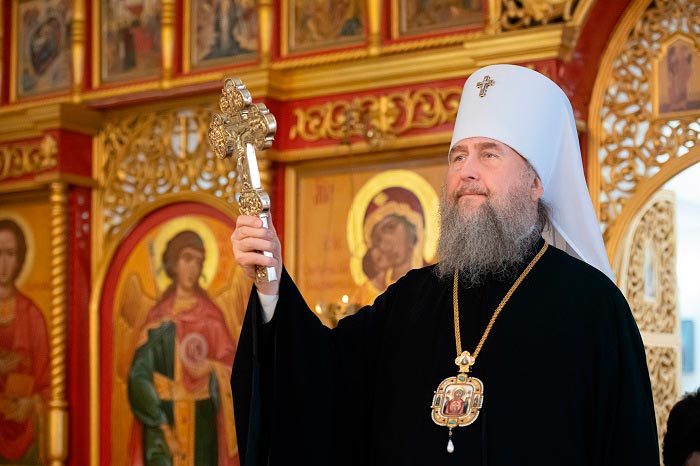
Dear brothers and sisters,
Humanity is crossing another historical threshold – one more year becomes part of history, and according to the civil calendar a new year begins. The change of seasons, and of days and years (Gen. 1:14), serves as a reminder to us of the swift and inexorable flow of existence, of our approach to the threshold of eternity. Observing the flicker of calendar dates, we learn to live, in the words of the Apostle, as wise people, redeeming the time (Eph. 5:15).
The Fathers and teachers of the Church poetically compare human life to the process of creating a book. Each new day in it is a clean page, each new year – a chapter; instead of ink – words and deeds. The image of opened books (Dan. 7:10; Rev. 20:12), with human deeds recorded in them, is present in the prophetic descriptions of the Last and Dread Judgment. People will stand before God, the Author of life, to hear what is written – either the bright lines of deeds of love or the dark pages of sin. Blessed Augustine explains that at that moment, by divine power, “all his deeds – both good and evil – will be reproduced in the memory and will arise before the mind’s eye with astonishing vividness, so that this knowledge will either condemn or justify the conscience.” An ordinary manuscript can be corrected – a wrong word crossed out, a damaged page replaced – but with the book of life everything is far more serious. As we open a new, clean page of this manuscript, let us remember the following rule, about which St. Theophan the Recluse warns: “Only recent deeds are remembered, and those which can no longer be concealed, but all other deeds have not disappeared either. Every thought, every feeling, every word and deed, every glance, even the slightest movement, leaves its trace.”
For the Creator, who has neither beginning of days nor end of life (Heb. 7:3), there is no past or future – He abides beyond time and space. For us, living within temporal limits, the past is irrevocable, the future unknown, and only the present is granted to us by God. Using today kindly and wisely, we can beneficially influence the future, for, in the words of the Apostle, whatever a man sows, that he will also reap (Gal. 6:7). Life according to the Gospel not only lifts us up with hope and opens the doors of divine mercy to people, but also, in response to sincere repentance, erases the mistakes of the past. The Lord Himself bears witness: “I, even I, am He who blots out your transgressions for My own sake, and I will not remember your sins” (Isa. 43:25). Wise Solomon said: “God requires that which is past” (Eccl. 3:15). This means that to everyone who believes in Him, the Creator gives the opportunity to begin everything from a clean page.
There is an old story-parable that is consonant with today’s reflections. Once a powerful and formidable king asked an elderly sage three questions: “Who is the most important person in the world?” “What is the most important moment in life?” and “What is the most important deed a person can do?” Puzzled by these questions, the sage set out on a journey through different lands, searching ancient writings and consulting renowned scholars and philosophers. On his way back to the king, having found no answer and already expecting disgrace and punishment, he met in a field a village girl herding geese. She stopped the old man: “Why do you look so sad?” The sage replied: “You would not understand.” “But tell me!” the girl insisted. He sorrowfully told her about the questions posed by the king, and the young interlocutor said with simplicity of heart: “The most important time is the present moment. After all, ‘yesterday’ is gone, and ‘tomorrow’ has not yet come. The most important person is the one who is with you right now – there is no other. And the most important deed is to do, in this very moment, for this person, whatever good deed you can.” Let us hasten to do works of light for our neighbors, for those who are near us, while we have life and time, while the Lord still grants us strength and opportunities.
According to an established pious tradition, many Orthodox Christians will meet the New Year not amid bustle and noise, but within the walls of holy churches, participating in Divine Liturgies and services of supplication. Together we will sanctify the beginning of the New Year by offering the Bloodless Sacrifice – the most holy Eucharist – “for the peace of the whole world,” for the well-being of our native Kazakhstan, that the Lord may show us His mercy, grant peace and prosperity. Let us certainly, with all our heart and all our mind, give thanks to the Lord for His benefactions. Gratitude is a beautiful trait of human character, highly valued in relations between people, and all the more necessary in communion with God. The Apostle calls us to this: “In everything give thanks; for this is the will of God in Christ Jesus for you” (1 Thess. 5:18).
After the civil New Year come the sacred days of the Church calendar – the time of the forefeast of the Nativity of Christ, when our thoughts and feelings should be directed toward the mystery of the coming of the Savior into the world. Let us strive to spend this final period of the fast in spiritual purity, in abstaining from all anger and vanity, in prayer, repentance, works of mercy, and attendance at church. “Grace, mercy, and peace will be with you from God the Father and from the Lord Jesus Christ, in truth and love” (2 John 1:3).





 Main
Main


Login or register, to write a comment!
Your comment has been successfully added and is currently being reviewed by the site administration