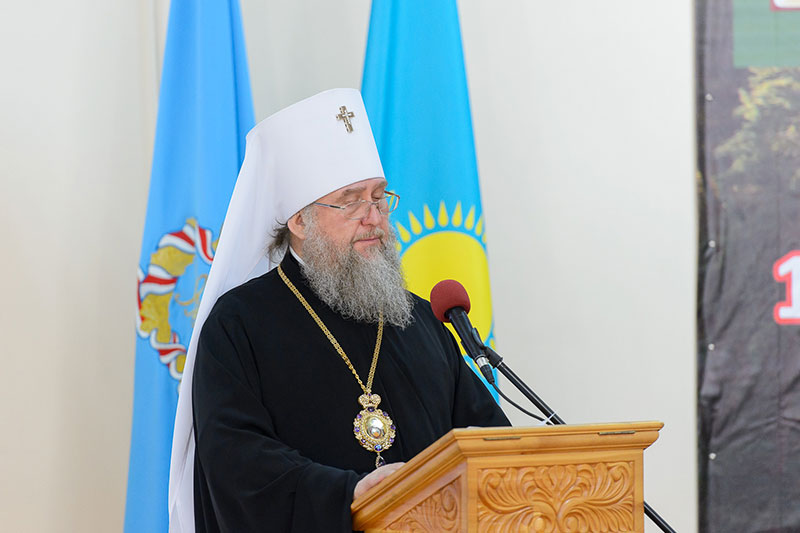
Honourable Fathers, dear brothers and sisters,
I greet the organisers and participants of the First Congress of Heads and Teachers of Sunday Schools of the Kazakhstan Metropolitan District.
For the first time, here in the spiritual and cultural centre bearing the names of the Equals-to-the-Apostles Cyril and Methodius, enlighteners of the Slavic peoples, have gathered specialists responsible for one of the demanding and responsible areas of ecclesial educational ministry.
It is entirely fair, as our President Kassym-Jomart Kemelevich Tokayev notes, that the rising generation holds a decisive role in the development of the country, and support of youth is a priority of state policy. Indeed, today’s young people are the future of society, the tomorrow of nations and peoples. Those who now sit at school desks or study at institutes and academies will very soon replace the older generation, will work, form families and bring up their own children. Therefore, it is essential to give children and adolescents a sound, comprehensive education, to form them properly and teach them a profession.
Yet the Orthodox Church looks deeper. The future of youth and the future of the nation depend to a great extent on the spiritual and moral choice a person makes in his early years. The loss by modern society of such Christian virtues as “goodness, meekness, faithfulness, gentleness, self-control” (Gal. 5:22-23) serves as a reason for even more active labour in the churching of children and youth.
We live in a world where notions of good and evil are being blurred. Actions which until recently were regarded as vice are being presented as virtue. People cease to conceal that which only a short time ago was considered shameful. Many noble qualities once seen as essential traits of a decent person are being dismissed as insignificant or even disadvantageous for comfortable living.
Yet we understand that “easy times” do not exist. The question of how to live rightly, how to save oneself and one’s soul, has always been relevant. For an Orthodox Christian, in every age, the answer is the same: life according to the Gospel. Every human act, every thought, either brings a person closer to God or leads him away.
Today the Church, as at all times, shows genuine concern for the fate of young people. In each human being she sees a person capable of freely accepting Christ. She seeks young souls not in order to enslave them by imposing a heavy burden of Pharisaic legalism, but to strengthen them by divine grace, nourish them with her love, temper them spiritually, make them capable of discerning good from evil and resisting an aggressively destructive immorality. It is here that children and adolescents can acquire true spiritual and moral reference points which will lead them to the inexhaustible Source of blessedness – union with God.
The organisation of effective work of Sunday schools in contemporary church life is given considerable attention. This topic has been repeatedly discussed at Bishops’ Councils and sessions of the Supreme Church Council. There is no diocesan meeting where the pressing issues of the upbringing of children and youth at parishes are not raised.
His Holiness Patriarch Kirill of Moscow and All Rus’ articulated the primary task of this work: to help children “enter into the life of the Church, find their place in it, and introduce them to Holy Scripture and Tradition, to liturgical life”. His Holiness pointed to a fundamental shortcoming of teaching in many Sunday schools, which orient themselves chiefly toward the practice of pre-revolutionary parish schools or modern secular education, offering rigid organisational requirements and an academic approach to lessons. “For some pupils,” His Holiness rightly notes, “the school model may be familiar, but for many it is burdensome. Such pupils lose motivation to attend Sunday school because they perceive it merely as a copy of regular school, with the difference that here they study not algebra, physics, or biology but Church Slavonic and church history.”
The traditional pedagogical model familiar to teachers – “acquisition of new knowledge – reinforcement – testing – grading”, which underlies reproductive educational methodology, is poorly suited for constructing catechetical instruction, because it does not attain its intended goal. When children are already heavily burdened in secular schools, Sunday schooling modeled after the secular one may alienate them not only from attending classes but also from the Church itself.
Therefore, our foremost task is, alongside familiar organisational approaches, to seek and adopt other methods that promote the introduction of children to the foundations of Orthodoxy. Each time an Orthodox teacher addresses a child or adolescent audience, he must relate himself to the new generation, attempt to understand young people with their questions, interests, and priorities, and strive to integrate the word of God into their value system so that it becomes intelligible, meaningful, and vital for them.
The Bishops’ Council of 2013 approved the Standard of Educational Activity for Sunday Schools and the Regulation on their Activity, drawn up by the Synodal Department for Religious Education and Catechesis. Experience has shown that this led to an improvement in the quality of educational work in many Russian Sunday schools. We must base our work on these documents, adapting their provisions to the realities of Kazakhstan. Thus we will be able to systematise the educational activity of Sunday schools in the parishes of the Kazakhstan Metropolitan District and improve the quality of spiritual education and upbringing of children and youth.
A significant aid to the administration and teaching staff of Sunday schools of Kazakhstan will be the educational platform “Clever Laboratory”, cooperation with which begins this year. It was created at the instruction of His Holiness Patriarch Kirill by the Synodal Department for Religious Education and Catechesis as an effective tool of methodological support for teachers.
Speaking of improving the quality of instruction in Sunday schools, we must understand that it is important not only, and not even primarily, to impart correct theoretical knowledge about God, the world, and man, but to form in children a deep Christian worldview and to develop moral sensibility.
“The aim of education in the light of Orthodoxy,” wrote the outstanding thinker and pedagogue of the last century, Archpriest Vasily Zenkovsky, “is to help children be freed from the power of sin through the grace found in the Church, to assist in revealing the image of God, and in unfolding the path of eternal life.”
Teachers, together with clergy, must help a pupil of Sunday school to recognise himself as a child of the Orthodox Church, to learn to be guided in his life by Gospel moral principles, and to raise his motivation for inquiry and knowledge.
We may teach children how to make the sign of the Cross correctly and when to make bows; they may know the dogmas, memorise prayers and biblical texts, but if in their souls the flame of love and faith does not begin to burn, sins and vices may easily coexist with these external forms of knowledge.
If a child is not turned toward the spiritual world, if no communion with God arises, and there remains only a formal list of rules and prohibitions, then our education will bear no fruit, and upon reaching adolescence a young man or young woman will leave the Church.
Without the experience of personal communion with God, a full-blooded spiritual life is impossible. A child’s participation in worship, and eucharistic communion with Christ, must occupy the central place in spiritual upbringing. We know that the reception of the Holy Mysteries of Christ possesses great power; it is capable of transfiguring and quickening the soul and body of a person in his earthly existence.
At the same time, a child, and even more so an adolescent, must not be compelled or forced to go to confession, to approach the Holy Chalice, to pray. The ability to interest, to inspire the pupil, to ignite within him that inner fire requires great effort on the part of the instructor, and at times endurance and patience.
I would like to say a few words about one of the key problems in the life of parish Sunday schools. Often one may observe the following: in the lower classes many children attend lessons, gladly fulfil the teacher’s assignments, take part in divine services and concert programmes, but this is no longer the case in the older groups. The so-called “adolescent period” comes, and imbalance arises in a child’s life. At this moment he is no longer always responsive, rejects the assistance of parents and teachers, and re-evaluates the values in which he was raised.
Engaging in Orthodox upbringing and education, we must bear in mind that such a crisis in the life of a pupil will come, and we must be prepared for it in advance. This period occurs earlier and earlier. If once it fell between fourteen and sixteen years of age, now these boundaries have shifted, and the time available for us to do anything has become shorter.
An adolescent is by no means a small child. It is necessary to avoid “paternalism”, that is, a condescending attitude of elders toward the younger. Commanding tones, ingratiation, excessive insistence, or tediousness are unacceptable. We must seek, find, and use a language capable of persuading children and adolescents to preserve their religious sensibility and loyalty to the Church even when age-related temptations arise and when they encounter a reality that is often spiritually empty, and at times hostile toward religion.
To avoid losing these young people, it is essential to include in work with them activities that genuinely interest them: sports competitions, excursions and pilgrimages, intellectual and creative olympiads, concert performances. In this way we give young people the opportunity to learn through action, to pass from passive consumption of information to active participation in acquiring knowledge. Such an approach overcomes the problem of children receiving theoretical knowledge without personal experience and divorced from their lives.
There exists, in my view, an effective means of making lessons in Sunday schools engaging for children of various ages. We must include in the curriculum that which brings them into contact with real life, offer practical lessons in which participants receive specific skills.
Observe how gladly children take part in divine services. It is one thing when a child stands through the service merely watching it from the side, often becoming bored, and quite another when he assists in the altar, sings and reads on the kliros, tidies the candlestand, or rings the bells. It is important for us to think carefully about ways of involving children and adolescents in practical liturgical activity.
With deep concern we observe how a habit of dependence on gadgets arises in people from a very early age. Even at nursery-age children are drawn into virtual reality. As a result, a deficit of practical activity develops within them. We must take into account the specificity of modern child psychology and attempt to make use of this deficit to foster children’s interest in religious education and in their introduction to liturgical piety.
Those activities we spoke of earlier, whether sports competitions, excursions, creative or intellectual contests, being real rather than virtual events, return a young person to contact with normal and proper life, including spiritual life. Therefore, I would like to draw attention to the need for this essential component to be included in our programmes of upbringing in Sunday schools.
There will be less boredom, less formalism and, above all, we shall develop what is now called interactivity, that is, the involvement of the child in the process of learning. To the illusory joy and superficial attraction of virtual life we must set in contrast the fullness and beauty of real life, illumined by the light of Gospel truth and warmed by the fire of prayer.
In the context of what has just been said, it should be noted that orienting oneself toward the real rather than the virtual world does not imply a rejection of new technologies. When used intelligently, both the internet and digital devices open new opportunities for us. They do not replace but rather complement our methodological tools. Therefore, modern means of information delivery in a children’s and student environment must be adopted to the extent that these technologies correspond to the subjects we teach.
In continuation of this theme, I would like to recommend that teachers interest older pupils in a project which, in my view, could be engaging for them. Adolescents may create and administer web pages of the Sunday school or parish. Undoubtedly, this work must be carried out under the strict supervision of teachers and clergy. Managing social media pages captivates contemporary youth to a remarkable degree and, importantly, allows the school’s boundaries to expand, to become acquainted with believers from various regions of the country and the world, and to implement diverse educational online initiatives that involve both children and their parents. It is significant that this form of work may also attract young people who are still outside the Church’s enclosure. Creating material for these pages engages adolescents; they sense their importance and their belonging to the life of the school and parish.
Another form of this activity may be the development of educational content involving the pupils: short videos, small films, visual sketches, and photo galleries. These will not only introduce Orthodoxy to online subscribers but will also allow children themselves to deepen their knowledge and look upon the faith and the Church from a new perspective.
Let us recall another important aspect in the life of parish Sunday schools. Engaging in the upbringing of children in Sunday school requires systematic work not only with the child but also with his family. The Lord Himself entrusted parents with the spiritual formation and nurturing of their children: “And these words, which I command you today, shall be in your heart, and you shall teach them diligently to your children” (Deut. 6:4–9). This chief responsibility rests first upon the shoulders of parents, and the school can only assist them in this if it shares their aims and values.
A child spends very little time in Sunday school. Children who encounter Orthodoxy only two hours a week and only within four church walls will grow up thinking that faith is merely a small, separate segment that need not, or should not, permeate all aspects of their life. Therefore, one of the most important directions of Sunday school work is uniting its efforts in upbringing with those of the family.
It is essential to foster such an atmosphere that the child is not “pulled” into church by adults, but desires to go there himself because he loves Christ and His Church, because he delights in being with believing peers and elder parishioners, because his parents are there with him and live the same life with him. For this to take place, the doors of the Sunday school must be opened not only for children but for the whole family, and strengthening the family should be advanced as a fundamental goal of educational and formative work within the Sunday school.
More often than not, parents know their obligations toward their children’s upbringing, but not all manage in practice to rear children as they should. Parents must know not only what to do but how to do it. Therefore, mutual respect must be the norm in relations between teacher and parent, enabling counsel, joint discussion, agreement on a common decision, and so forth. The teacher must show trust in the educational potential of parents.
Believing or newly church-going parents often strive to place their child within a good spiritual environment so that someone else might teach him to pray, speak to him about salvation, or correct difficult traits in the character of their son or daughter. Yet a different approach is required. Alongside regular Sunday lessons for children, one may try at least once or twice a month to hold thematic conversations with parents. During Sunday school classes it is important to speak more frequently about the value of the family, obedience toward elders, and honour for father and mother. And for talks or lessons addressed to the parents, along with the dogmatic foundations of the Christian faith, it is necessary to select themes which allow a deeper understanding of the nature of Christian marriage, the role of husband and wife, and the tasks of upbringing and nurturing personality.
However, it is not enough simply to hold occasional discussions on religious themes. One must organise such a system of teaching that parents will “walk in step” with their children. One might begin by informing parents about what their children are studying in class. Later, this informational space may be gradually expanded toward catechisation, making it relevant to the interests of an adult. It is also important to know the difficulties and needs of each family: what they require, how the child is growing, and how he is studying. This family-centred approach should be maintained throughout the academic year.
Children must from an early age be accustomed to works of mercy. In former times these skills were instilled within church-oriented families. Today this is also one of the tasks of Sunday schools. “If we love our pupils,” the great educator Sergei Alexandrovich Rachinsky often repeated, “we shall not rest until we awaken active goodness in them, until we move them to good works. This is the best and only safeguard against evil and vice. Exercise the will not only in refraining from evil but also in doing good. This gives the spirit boldness and at the same time teaches humility, for doing good is harder than avoiding evil.”
Social and charitable work is carried out in our parishes, and children can and should take part in it: together with elders visit the elderly and infirm, prepare simple gifts with their own hands, or organise a small musical programme, help with cleaning or buying provisions. The older generation will remember how in certain schools pupils were assigned care over lonely elderly people. This wholesome practice is needed today as well. Where clergy have access to homes for the aged or children’s shelters and cooperation with the institution’s leadership is possible, it is worth organising parish Sunday school activities timed to church or civic feast days.
Love, mercy toward neighbours, compassion, the ability to show solidarity, the capacity to weep with those who weep and rejoice with those who rejoice (Rom. 12:15) - these are our chief testimony of Christ. They are what we ourselves must learn and what we must teach our children.
In concluding my address, I would like to remind you of one principle that is important for all of us: a teacher must continually learn so that the subject he teaches does not lose its appeal for students. What does it mean to learn continually? It is not enough to know one’s subject excellently. It is important to connect it with life. Detached from reality, it will become dry and useless. Therefore, examples from life, references to various situations, engaging historical sketches, and analysis of contemporary events help children to perceive Christianity contextually, in firm connection with what they know, what is familiar to them, and what surrounds them in daily life. Thus, teaching in a Sunday school must never be separated from our life. Lessons must always be filled with vivid and memorable examples. These may be drawn from the lives of the saints, from the lives of heroes of the past, or from the lives of notable contemporaries.
A modern parish school must be established and act according to the principles of Gospel truth, goodness, and beauty. By the mercy of God, the results that we see today in our blessed Kazakhstan bring joy and hope. Now we must consolidate and develop what we already have. This is of course difficult, but we must not forget that the power of God is made perfect in weakness (2 Cor. 12:9).
I would like to thank all of you for your difficult labour, which requires sacrifice, endurance, patience, and of course great love for God, for Orthodoxy, and for children. By raising the younger generation, you strengthen the foundation of the Church of Christ, you contribute to the building of its future, and you fulfil in deed, not merely in word, the command of the Saviour to preach the Gospel in the world. Concluding my address, I turn to all of you with the consoling words of the apostle Paul: “Be steadfast, immovable, always abounding in the work of the Lord, knowing that your labour is not in vain before the Lord” (1 Cor. 15:58).





 Main
Main


Login or register, to write a comment!
Your comment has been successfully added and is currently being reviewed by the site administration