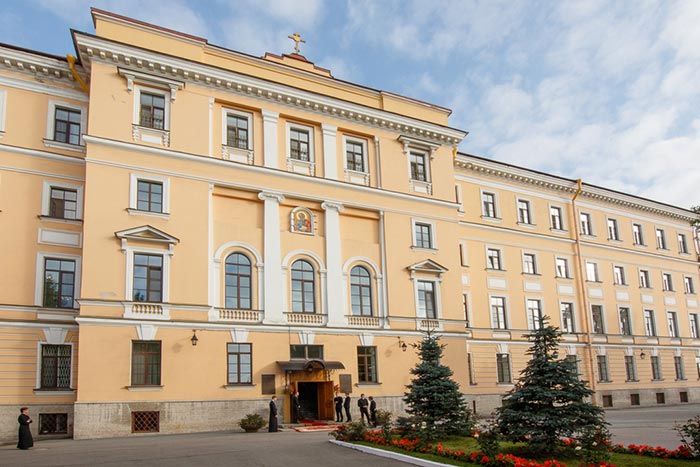
September 4, 2026. St. Petersburg, Russia. The Head of the Orthodox Church of Kazakhstan, Metropolitan Alexander of Astana and Kazakhstan, who is making a pilgrimage to the shrines of the city on the Neva at the invitation of Metropolitan Barsanuphius of St. Petersburg and Ladoga, visited the St. Petersburg Theological Academy.
At the Academy, Metropolitan Alexander met with Bishop Silouan of Peterhof, Rector of the theological schools of the city on the Neva. The meeting focused on cooperation between the Alma-Ata Theological Seminary and the higher Orthodox educational institution of the Northern Capital.
The meeting was attended by O.N. Ovchinnikov, Secretary of the Kazakhstan Metropolitan District, Honored Worker of Kazakhstan and Honored Art Worker of Russia, and P.V. Sokolov, Personal Secretary to the Metropolitan.
Bishop Silouan told Metropolitan Alexander about the life of the St. Petersburg theological schools, which this year are marking a historic anniversary – 80 years since their restoration in 1946. The Rector informed the Head of the Kazakhstan Metropolitan District about the planned celebrations, which will be led by His Holiness Patriarch Kirill of Moscow and All Rus’.
Metropolitan Alexander shared with Bishop Silouan his memories of his years of study at the theological schools of the city on the Neva and, in particular, of the entrance examinations conducted by the present Primate of the Russian Orthodox Church, His Holiness Patriarch Kirill.
“Next year will mark exactly half a century since the Lord granted me the opportunity to become a student of the theological schools of the city on the Neva.
“I remember those days when, despite the dominance of atheist ideology in the country and the immense difficulties the Church faced every day, we – young people who had chosen the path of serving our native Orthodoxy – had the privilege of studying under outstanding professors and talented, remarkable teachers, under the wise leadership of the Rector at that time – Bishop Kirill of Vyborg, now Patriarch of Moscow and All Rus’,” the Metropolitan noted.
“The unique atmosphere of our theological school,” the hierarch continued, “was created by its faculty. Some teachers, such as Professor of Dogmatic Theology Archpriest Liveriy Voronov, had traveled a long path through life and knew from personal experience what repression and persecution meant. Father Liveriy was a very sincere man, yet at the same time cautious, carefully weighing every word he spoke.
“I remember the Biblical History classes taught by Igor Tsezarevich Mironovich, an outstanding scholar of the Holy Scriptures of the Old Testament. His lively and engaging lectures radiated a profound love for the Biblical texts, and he regarded instilling that same love in his students as one of his principal tasks. I was recently presented with a book containing Igor Tsezarevich’s lectures on the Sacred Biblical History of the Old and New Testaments. It is an excellent publication that I strongly recommend both seminarians and clergy to read.
“I also gratefully remember Professor Nikolai Dmitrievich Uspensky, a survivor of the Siege of Leningrad, a renowned liturgist, serious scholar and distinguished specialist in history and art history, as well as the professors Archpriests Vladimir Sorokin, Vasily Stoikov, Ioann Belevtsev, Georgy Telpis, and many others.”
Metropolitan Alexander told Bishop Silouan about his scholarly work – the search for and study of materials relating to the life and labors of Archbishop Sophonias (Sokolsky), an ascetic and righteous man, the first archpastor of the Turkestan Diocese and the Apostle of Central Asia.
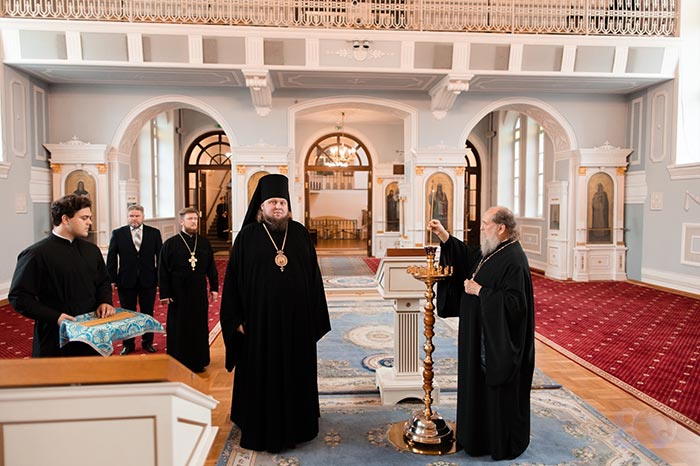
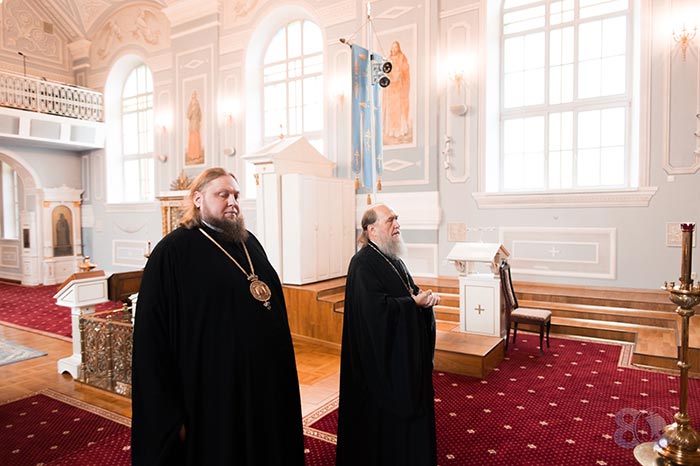
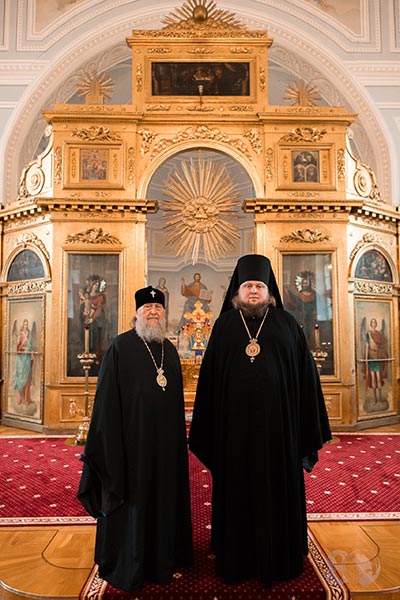
At the Academy’s house church dedicated to St. John the Theologian, the Head of the Metropolitan District offered prayers before the wonderworking “Sign-Tsarskoye Selo” Icon of the Most Holy Theotokos.



 Main


Login or register, to write a comment!
Your comment has been successfully added and is currently being reviewed by the site administration