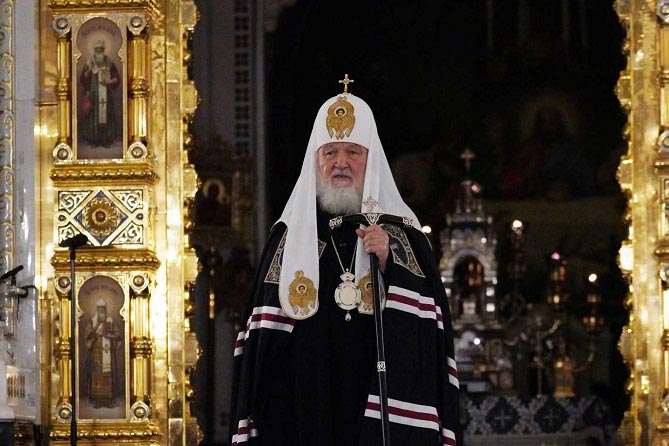
On the evening of 22 February 2026, on Cheesefare Sunday, the commemoration of the Expulsion of Adam (Forgiveness Sunday), His Holiness Patriarch Kirill of Moscow and All Rus’ prayed at Vespers and presided over the Rite of Forgiveness at the Cathedral of Christ the Savior in Moscow. After the dismissal of Vespers, His Holiness delivered a sermon.
With this service we have entered upon the arena of Great Lent. As we all well know, the Fast is a time of self-restraint, involving abstinence from certain foods and from various entertainments. And of course, the Fast presupposes a special concentration of our attention upon prayer.
Every Orthodox person prays morning and evening, but the Fast places before each of us a requirement to renew our attitude toward prayer. Not merely to recite words that are familiar to us, but during prayer truly to turn to God, even if using the words of the prayer book and not only our own.
For prayer establishes the bond between a person and the Lord, and there is no other bond with Him. Only prayer. Therefore neglect of prayer is a kind of self-torment. If a person does not pray, why should he go to church at all? If he does not pray, why observe any ritual prescriptions? If there is no prayer—sincere, heartfelt, filled with faith—then everything else is “a sounding brass or a clanging cymbal” (cf. 1 Cor. 13:1), a kind of ritualism which may appeal to someone aesthetically but is unlikely to bring benefit.
If we go to church or read prayer texts at home, this means we participate in prayer. But prayer must not be only the utterance of certain words. We must concentrate our attention. We must exert our strength. We must stand before the face of God—before our Judge, our merciful Father—and address to Him words that are truly important for us. For we ask Him for what is genuinely important, without which life becomes difficult.
Such an attitude toward prayer greatly mobilizes a person, though it may sometimes be tiring. In my time I asked Athonite monks, “You live in such difficult conditions—with fasting and various restrictions—what is the hardest thing for you?” Very often I heard in reply, “The hardest thing is prayer.” And indeed it is so.
But if a person has no experience of prayer, he cannot consider himself a believer. The very word “religion,” translated from Latin, means “bond” or “connection”—a bond with God. And this bond is established only through prayer. No prayer—no connection with God, no religion. Religion remains merely a cultural or historical phenomenon, but it loses all its power. A person who does not pray vainly calls himself a believer, for how is faith expressed if there is no bond with God?
Therefore, once again, let us say to ourselves: during Great Lent, whether attending services or praying at home, let us pay special attention to the quality of our prayer. There is no need to attempt the impossible. There is no need to impose extraordinary demands upon ourselves. The most important thing is clearly to realize that we stand before God, and that only prayer binds us to the Lord. If there is no prayer, there is no connection, and therefore no religious feeling.
This is what I wished to say on the threshold of Great Lent, for the Fast disposes us to prayer. Most Orthodox people attend services both morning and evening, especially during the first week of Great Lent. If they work in the morning and cannot come, they often come in the evening to pray during the Canon of Andrew of Crete. In other words, the Fast is a time when even a person not very churched considers it necessary to come to church more often and thus to raise his prayer to God more frequently.
There is, however, another very important action that helps a person change himself during the Fast as far as possible—this is abstinence. For this reason the Church proposes abstinence from certain kinds of food. Someone once said to me: “What difference does it make what I eat? It’s not what enters me but what proceeds from me. I try not to offend people, not to say bad words, so why should it matter whether I eat sausage or bread in the morning?” From a secular point of view, this may seem logical. But in fact it is a great mistake, because abstinence from food is the taking upon oneself of certain obligations before God.
Of course, God does not need our fasting days—He is almighty, the Creator of the world. We need them. If for God’s sake we limit ourselves in the kinds of food to which we are accustomed and in which we find pleasure, and if we do so not mechanically but with religious meaning—“This is my small sacrifice to the Lord; I believe He will accept it and help me draw closer to Him”—then fasting becomes a means of renewal. Thus prayer and abstinence are ways and means of renewing our spiritual life during Great Lent.
The Forty Days are long, and one cannot endure them on mere emotional enthusiasm. To preserve the discipline of Great Lent, first, firm conviction is needed that this is truly necessary. And second, an understanding that even small efforts on our part—abstinence from food, attendance at services—are the only means by which we, sinful and unworthy, bound by earthly life, falling yet rising again, can draw nearer to our Lord and Savior. If this were not so—if the Fast did not lead to such lofty goals—no one would ever fast. Why would they? The Fast passes, and nothing changes, perhaps even things worsen.
Sometimes this even happens. As one pious elderly woman once told me, there can be “prayerful irritability.” She lived in a monastery, and as a young man I spoke with her. She spoke of this “prayerful irritability.” I asked, “What does it mean?” She replied, “A person fasts and prays, yet becomes even more irritable.” Why? Because fasting weakens physical strength, affects the nervous system, and if it is not accompanied by sincere prayer, it can provoke negative emotional reactions.
Therefore one must never fast apart from prayer. One must not fast and avoid church. One must not fast and neglect the Word of God. Otherwise, restriction in food may not serve for good but may lead to spiritual problems.
Prayer and abstinence from food are important factors that help a person change his way of thinking and influence his feelings. But this is possible only when prayer and abstinence are not automatic, merely ritual, bordering on folklore or custom. Otherwise, little benefit will come from either.
While attending church during Great Lent, we must ask the Lord for many things. During the long services we may also reflect upon ourselves—analyze our life and conduct. Such self-examination is very necessary for an Orthodox Christian and does not require a third party—you alone before the Lord. Of course, to receive forgiveness of sins, one must confess before a priest in church, but in one’s cell or room one can do much to correct one’s spiritual trajectory.
Reflection upon oneself, prayer to the Lord, abstinence, repentance create the best conditions for spiritual growth. Thus the Fast is not a burdensome time, not some heavy yoke laid upon a person. On the contrary, it helps us become better, renew our spiritual strength, draw nearer to the Lord, and learn—this is very important—a different attitude toward our neighbor. To see in them those whom we ought not to offend, for every offense destroys the fabric of good relationships and is dangerous both for social life and for our spiritual condition. Preserving peace with those around us is no less important than observing the Fast by limiting ourselves in certain foods.
Thus prayer and abstinence from actions that harm our communion with others are the forces and means with which we must arm ourselves during Great Lent and use them so that our spiritual life and we ourselves may truly change for the better. And may the Lord help us to pass through the arena of Great Lent in prayer, in abstinence, in self-control, in struggle against weaknesses and spiritual ailments known only to ourselves, so that on the radiant day of Christ’s Resurrection we may not only hear the joyful hymns of the services but also feel the joy of change in our own lives. Amen.
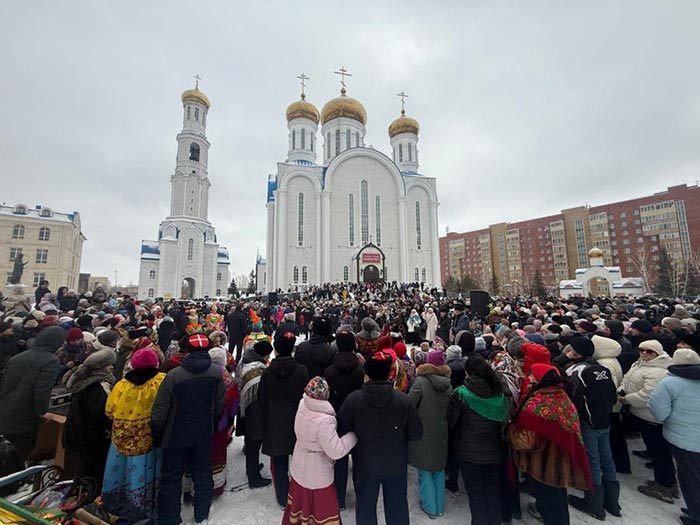
In Astana, the concert “Wide Maslenitsa” was held
More details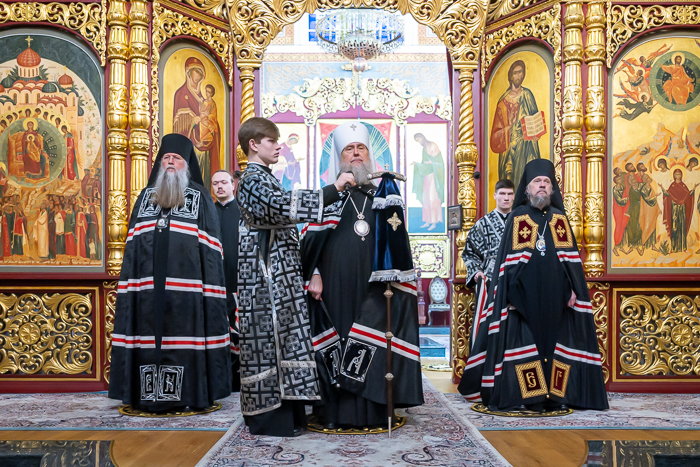
In the Ascension Cathedral of Almaty, the Head of the Metropolitan District celebrated Great Vespers with the Rite of Forgiveness
More details
Sermon of His Holiness Patriarch Kirill of Moscow and All Rus’ before the Rite of Forgiveness at the Cathedral of Christ the Savior
More details




 Main
Main


Login or register, to write a comment!
Your comment has been successfully added and is currently being reviewed by the site administration