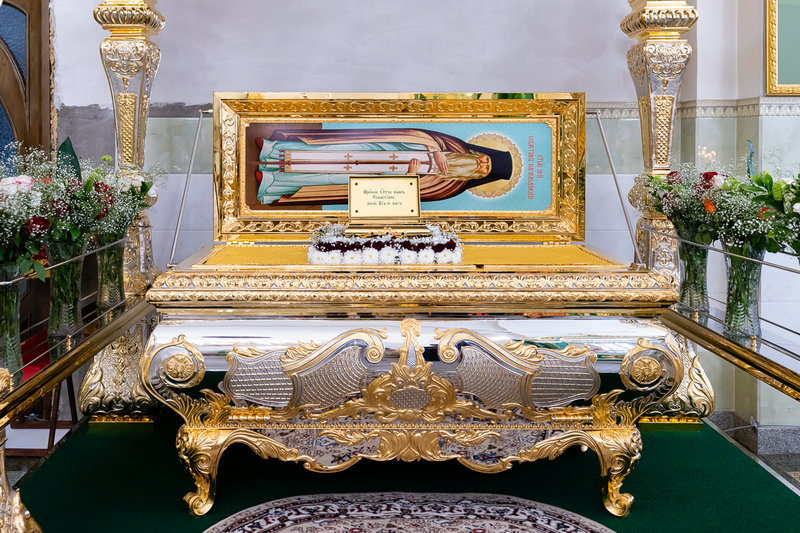
This year, the Russian Orthodox Church marks the 60th anniversary of the repose of an outstanding ascetic of faith and piety – the Venerable Elder Sebastian of Karaganda, a confessor.
His earthly life ended early in the morning of April 19, 1966, on the memorial day of Radonitsa. On the eve, his caring disciples would bring the elder from his small house-cell to the church, where he attentively listened to the memorial service, often made the sign of the cross, and was deeply focused on his spiritual state. The Venerable one rejoiced that he had managed “to exchange the Paschal greeting with all the departed and to pray for them.” Meanwhile, throughout the night the church was filled with people – the elder’s spiritual children, who came from various places to witness the final hours of his earthly life. Among those who arrived was the recently appointed head of the Publishing Department of the Moscow Patriarchate, Bishop Pitirim of Volokolamsk, who would be granted the honor of performing the funeral service for the Venerable one, since Metropolitan Joseph of Alma-Ata was ill and could not be in Karaganda at that time.
At that time, in April 1966, the small church in honor of the Nativity of the Mother of God, located in the settlement of Bolshaya Mikhailovka, now an outskirt of Karaganda, could not accommodate even a small portion of those praying. But let us return to the distant year 1939, when the elder had just been released from imprisonment, and some time later, with his blessing, one of the small adobe houses was secretly adapted for the reading of the prayer rule. Around this prayer house the well-known women’s monastic community was formed, consisting of the Venerable one’s spiritual children. However, it was dangerous to gather regularly in the same place, so in the mornings and evenings believers gathered for common prayer in different premises, in private apartments. The elder himself spent most of his time in the prayer house, including performing household tasks there: he carried water, cooked meals, repaired shoes. Often the Venerable one himself went to the shop for bread, standing in long queues.
In the early 1940s, a prolonged struggle began among the believers of Karaganda for the opportunity to celebrate services legally. Only in 1955 did they achieve the necessary permission, and the prayer house in Bolshaya Mikhailovka became a fully functioning church.
In 1976, the Nativity church was expanded, its clay walls replaced with brick, and to this day it remains a witness to the high spiritual life of the Karaganda faithful in the postwar period. Already in our time, a memorial cell of the Venerable Sebastian has been created at the church, where many of the elder’s personal belongings are carefully preserved.
The significance of the life feat of Saint Sebastian of Karaganda cannot be overestimated. In Karaganda he created a powerful spiritual movement, becoming the source of a full-flowing river leading to eternal life, which even now draws more and more followers into its current.
It is enough to visit the mining capital of Kazakhstan once to be convinced how great the ever-memorable elder is, and how attentively and reverently his precepts are observed. His instructions, teachings, and counsel are known by heart by every Orthodox resident of Karaganda. In the Nativity of the Mother of God monastery, the order established by the elder for the use of liturgical vestments is preserved: during fasting days services are celebrated in green, which is associated with the ascetic struggle of the venerable saints, and on their feast days – in blue, which symbolizes the heavenly purity of the ascetics.
Archimandrite Sebastian (Fomin) is not merely an ascetic of faith and a sufferer for the name of Christ, of whom there were many in the years of fiery trials that befell the Orthodox Church. He is a holy heir to the grace of Optina eldership, and it was destined for him to spread the light of Optina Hermitage across the boundless expanses of the Great Steppe of Kazakhstan.
In February 1917, in the Moscow family of the Shatrovs, a remarkable prophecy of Venerable Anatoly (Potapov), one of the last elders of Optina, was recorded: “There will be a storm. And the Russian ship will be broken. But even on splinters and fragments people are saved. And yet not all will perish. One must pray, all must repent and pray fervently… A great miracle of God will be revealed… And all the splinters and fragments, by the will of God and by His power, will gather and unite, and the ship will be restored in its beauty and will go on its course appointed by God.” It may be said that the personality of Elder Sebastian is one of those precious fragments of that ship which the stream of time brought into the Kazakh steppe.
For thirty years, around him a new spiritual construction took place, in which souls were united, inflamed by the fire of Orthodox faith and zeal in Christian piety. These were suffering souls who had endured the most severe trials that can befall a person in his earthly life. These were former prisoners of the Karaganda corrective labor camp – the largest in the inhumane system of the Gulag – exiles who had lost property, relatives, health, and any hope of returning to normal human life in a godless country.
Coal deposits in the area of modern Karaganda were discovered as early as the 1830s, and industrial extraction began in 1857. In the 1930s, by decision of the Soviet government, the creation of the “third coal base of the country” began here – after Kuzbass and Pechora in the Komi Republic.
“What a vast space for thought and labor!
What a force of daring and will!
Who, magician, in the boundless field
Raised these cities for posterity?”
– the poet Nikolai Zabolotsky admired.
But behind the bright façade of large-scale industrial construction lay countless human sufferings. All work in the Karaganda steppe was carried out by prisoners or so-called special settlers. At first these were dekulakized peasants – tens of thousands of strong peasant families. Then came political prisoners – intelligentsia, clergy. Zabolotsky himself endured the full measure of suffering. The poet arrived in Karaganda in 1945, having already passed through Dalstroy camps and Kuzbass camps, endured torture in the prisons of the secret police, and miraculously avoided insanity. Zabolotsky’s son, Nikita, recalled that at first they settled in Mikhailovka, and it is quite possible that the great saint and the outstanding poet met on the streets of the outskirts.
In Father Sebastian, believers immediately felt spiritual light and warmth. They were drawn to him for consolation and support. It is striking that the Venerable one himself endured no fewer trials than those who sought spiritual help from him. In 1944, Father Sebastian turned sixty, six of which he had spent in harsh camp labor. At one time he transported water on oxen for industrial gardens – in winter, in forty-degree frost, this was especially difficult. Sometimes he was given mittens, but they were immediately taken away. His frozen hands had to be warmed by placing them on the warm back of an ox. And often he had to spend the night in cattle stalls, warmed by the animals.
The elder was afflicted with bodily infirmities. But after all his sufferings, he did not lose heart; on the contrary, he acquired great spiritual strength. “He tested them like gold in the furnace and accepted them as a perfect sacrifice” (Wisdom 3:6), says Holy Scripture about the righteous. “Not only the wicked, but also the good benefit from humiliation and suffering. Sorrows help the saints to become humble and meek,” teaches Saint John Chrysostom. Of the elder one could say in the words of the Apostle: “having himself been tempted, he is able to help those who are tempted” (Hebrews 2:18).
The core of the community in Bolshaya Mikhailovka consisted of nuns who, like the Venerable one, were connected with Optina Hermitage. The true source of the elder’s spiritual strength was the grace with which he was nourished in Optina and which he carried through his entire life without losing it.
Archimandrite Sebastian (Stefan Vasilyevich Fomin) was born in 1884 in the village of Kosmodemyanskoye, Oryol province, into a poor peasant family. At the age of four, his parents brought him to Optina for the first time. At that time, Venerable Ambrose – the all-Russian elder, a hieroschemamonk and one of the most revered saints of the nineteenth-century Russian Orthodox Church – was still alive. The visit to the renowned monastery made an indelible impression both on Stefan and on his elder brother Roman. The latter entered Optina first in 1892 and received monastic tonsure with the name Raphael. However, having weak health, Father Raphael died in 1913.
Stefan entered the monastery in 1905, and four years later he was appointed cell-attendant to Elder Joseph. The very fact that the young Stefan was chosen testifies that the spiritually experienced elders had already discerned in him the qualities necessary to inherit the grace of eldership.
This obedience was providential: Stefan not only absorbed the spiritual light of Optina Hermitage, but also for several years received invaluable lessons of elder guidance. The stream of people coming to Elder Joseph did not cease, and his humble attendant observed how, under the elder’s guidance and through the practice of confession of thoughts, the spiritual growth of the faithful took place, how wise counsel helped resolve difficult problems, and how a proud and unreasonable soul that rejected instruction would be visited by divine correction.
On October 28, 1910, on one of Stefan’s birthdays, he witnessed the final spiritual tragedy of Leo Tolstoy, who had been excommunicated from the Church. The great writer came to the monastery, stayed at the guesthouse, asked whether Elder Joseph was well, approached the gates of the skete twice, but did not dare to enter. A few days later Tolstoy died at the railway station of Astapovo. Yet, with the blessing of the Holy Synod, it would have been enough to say a single “I repent” to a priest in order to receive Communion, but no priest was allowed to approach him. “Though he was a lion, he could not break the chains,” said Venerable Barsanuphius of Optina.
After the death of Elder Joseph, Stefan became the cell-attendant of the last conciliar elder of Optina, Venerable Nectarius. In 1917 he was tonsured into the mantia with the name Sebastian, and a year later Optina was closed. For some time the monastic community existed under the guise of an agricultural cooperative, but in the spring of 1923 it too was dispersed. During this same period, Father Sebastian was ordained a hierodeacon, and in 1927 he was ordained to the priesthood and began parish ministry.
For several years Hieromonk Sebastian served in the Church of the Prophet Elijah in the city of Kozlov, now Michurinsk, of the Tambov diocese. When the rector of that church, Archpriest Vladimir Nechaev, was arrested, Father Sebastian took upon himself the care of his children, among whom the youngest son Konstantin stood out for his abilities and diligence – the future Metropolitan Pitirim. This prominent hierarch left very valuable recollections of the elder. From them we learn, for example, about a severe illness that accompanied him for most of his life: paralysis or paresis of the esophagus. The hierarch recalls: “All his life he could eat only liquid, soup-like food: mashed potatoes with kvass, mashed apple – very little, liquid, and a soft egg. Sometimes a spasm would seize his esophagus, he would begin to cough and could no longer eat, remaining hungry. One can imagine how difficult it was for him in the camp, when they fed herring and gave no water.” It was in Kozlov that Father Sebastian was arrested in 1933.
Near Optina, as is well known, stands the Shamordino Convent, founded by Venerable Ambrose. The nuns of the monastery received spiritual guidance from the elders of Optina. Some of them were spiritual children of Father Sebastian and followed him to the Tambov region. The names of three are well known: Agrippina (Artonkina), Fevronia (Tikhonova), and Varvara (Sazonova). These ascetics were arrested for anti-Soviet activity together with the elder. Agrippina was exiled to the Far East. After being released from exile in 1936, Mother Agrippina purchased that very first clay house in Bolshaya Mikhailovka. The nuns showed remarkable obedience to the elder. It should not be forgotten that all of them came from Central Russia, were spiritually formed in renowned monasteries, and perceived the Karaganda steppe as a foreign land. Their hearts longed for their homeland. Everyone expected that after his release from imprisonment, the elder would decide to return to regions near Kaluga or Tambov. But the Venerable one remained in Karaganda. Addressing the sisters, he said: “Here we shall live. Life here is different, and the people are different. The people here are kind-hearted, thoughtful, and have endured suffering. Therefore, my dear ones, we shall live here. We will bring more benefit here; this is our second homeland. I remain.” And the spiritual ascetics stayed with him. New sisters also arrived. In 1952, by the elder’s blessing, schema-nun Agnia (Starodubtseva), a spiritual daughter of the Bogoroditse-Znamensky Sukhotin Monastery of the Tambov province, known for its icon-painting school, came to Karaganda. The mother wrote several remarkable icons for the church in Mikhailovka, among which the icon of the Most Holy Theotokos “Quick to Hear” remains especially venerated to this day. Other works of hers can be seen in many churches of Kazakhstan. It was Nun Agnia who, after the elder’s repose, took upon herself the care of the orphaned sisters.
The women’s monastic community founded by Venerable Sebastian received the official status of a monastery only in 1998. Yet even before that, for many years it stood as an example of piety, love, and mercy, drawing many people into the life of the Church. The significant date of the 60th anniversary of the repose of Venerable Sebastian calls us once again to turn our attention to the feat of the new martyrs and confessors of the last century. To this day, more than one and a half thousand sufferers for the Name of Christ have been glorified by name in the Russian Orthodox Church. It may be assumed that this process is far from complete. A deep interest in the lives and подвиг of those who suffered for Christ arose in our country in the late 1980s, when terrible truths were revealed, documents were widely published, and sites of mass executions and burials of the innocently repressed were discovered. Memoirs of eyewitnesses were published in large editions, and the lives of the new martyrs were compiled. At that time, it seemed that with the passage of time this interest would only increase.
Today, however, we observe a very different tendency, which cannot but cause concern – attention to the lives and подвиг of the new martyrs is weakening. Moreover, from time to time in secular and near-church journalism there appear articles expressing doubt: is it necessary to give so much attention to the martyrs? “Yes, of course,” some write, “there were priests and believers who suffered unjustly, but there were also those who were rightly condemned – for politics, for resistance to authority.” Sometimes the idea is put forward that those who oppose authority cannot be widely venerated. But allow me: what can be considered resistance to authority? If authority desecrates and destroys churches, eradicates holy things, and tramples all morality, how can one not resist it?
Up until 1990, it was categorically forbidden in the Soviet Union to teach children religion. The study of Holy Scripture together with children was classified as a criminal offense. The corresponding article of the criminal code punishing violations of the laws on the separation of Church and state was abolished only in 1991. The dissemination of religious knowledge under the Soviet regime was a crime from the point of view of the law, but at the same time it was the fulfillment of the direct command of Christ the Savior to teach all nations the Gospel (Matthew 28:19).
In personal and trusting communication, Christians in those years strengthened one another, recalling the episode from the fourth chapter of the Acts of the Apostles, when the elders and rulers commanded the Apostles Peter and John not to speak or teach in the name of Jesus. To this Peter and John replied: “whether it is right in the sight of God to listen to you more than to God, judge for yourselves” (Acts 4:19). Under the conditions of the atheistic regime of the Soviet period, every Christian who acted according to religious conscience sooner or later faced the risk of repression. Even in the relatively calmer 1980s, neither clerical rank nor high social status protected one from persecution for the faith.
And how can one not recall the simple and clear words of Venerable Sebastian, fearlessly spoken during interrogation. They were recorded by the investigator and are preserved in the materials of the criminal case: “I regard all actions of the Soviet authorities as the wrath of God, and this authority is a punishment for people. Such views I expressed among those close to me, as well as among other citizens with whom I had occasion to speak on this subject.” To question the necessity of honoring the memory of the new martyrs in Russia and Kazakhstan is equivalent to advocating the forgetting of the horrors of the Second World War. Venerable Sebastian himself gives us an example of reverent remembrance of those who suffered innocently in the years of repression. Witnesses recount how he visited cemeteries with mass graves, where special settlers who died from hunger, cold, and exhausting labor were buried. They were simply interred without the Christian rites of burial – without mounds, without crosses. The elder would look at these graves, listen to terrible accounts, pray for the departed, and once said: “Here, day and night, over these common graves of martyrs, candles burn from the earth to heaven.”
The veneration of those who suffered courageously for the truth of God unites people spiritually and morally. Therefore, further efforts to preserve the memory of the martyrs for the faith can only be welcomed. In the Kazakhstan Metropolitan District, such work has continued for many years. For example, in 2025, with the blessing of the Patriarch, a new memorial church was erected in memory of those innocently killed on the outskirts of Shymkent, at the site of mass executions of clergy.
When Venerable Sebastian lay on his deathbed, his spiritual children asked him sorrowfully: “How shall we live without you?” The elder replied firmly: “Who am I? What am I? God was, is, and will be! Whoever has faith in God will be saved, even if he lives thousands of kilometers away from me. But whoever clings even to the hem of my robe without fear of God will not receive salvation.” And today we are confident that Venerable Sebastian helps by his prayers those who live according to the commandments of God and faithfully honor the memory of the holy elder.
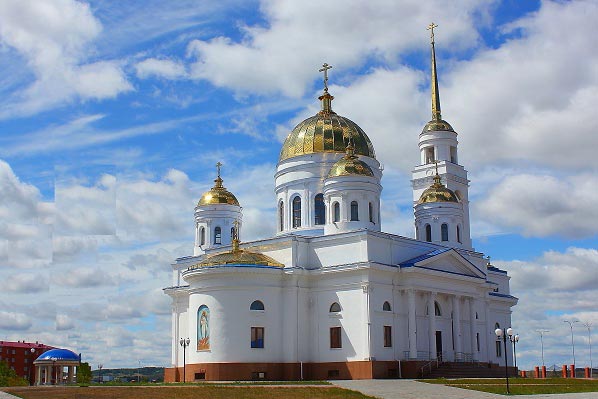
Diocesan Assembly of the Clergy of the Kokshetau and Akmola Diocese Held in Kokshetau
More details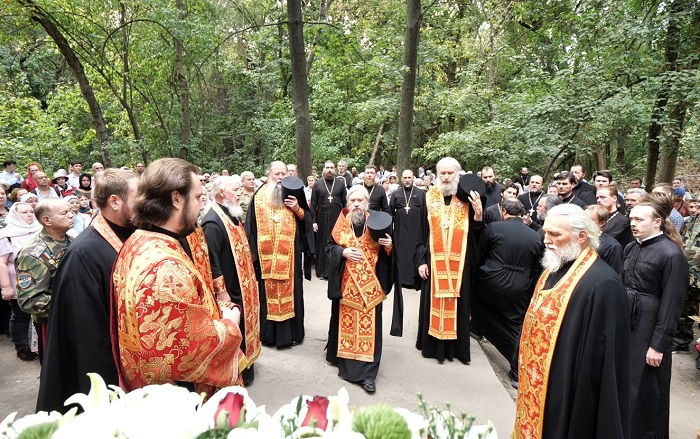
Commemoration of Hieromartyr Pimen, Bishop of Verny and Semirechye, Observed in Alma-Ata
More details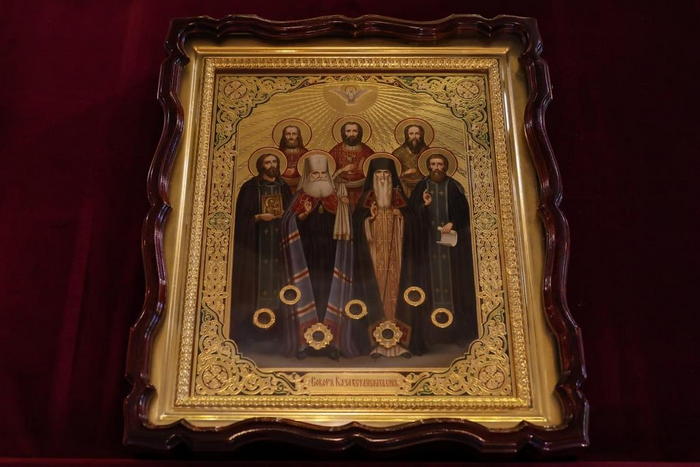
Metropolitan Alexander Celebrated the Liturgy at the Representation of the Kazakhstan Metropolitan District in Moscow on the Feast Day of Hieromartyr Pimen of Verny
More details




 Main
Main


Login or register, to write a comment!
Your comment has been successfully added and is currently being reviewed by the site administration