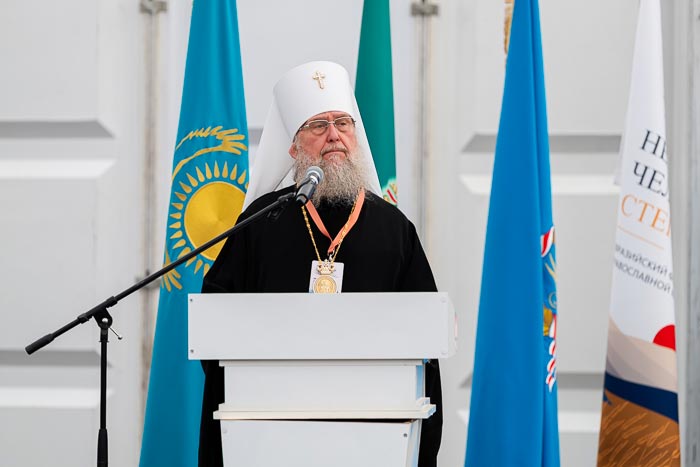
Your Graces, reverend fathers, dear brothers and sisters,
I warmly welcome the organizers and participants of the Eurasian Orthodox Youth Forum “Sky. Humanity. Steppe.”
It is a joy that, during this wonderful summer season, here in the heart of the Eurasian continent, young men and women from different countries—representatives of diocesan youth organizations together with their spiritual mentors—have gathered for fellowship and fruitful collaboration. We are also pleased to welcome the leadership of the Synodal Department for Youth Affairs of the Russian Orthodox Church, along with distinguished Church and public figures. I am confident that their participation will make the forum not only productive but also engaging.
This youth gathering would not have been possible without the generous support of our benefactors. I would like to express my sincere gratitude to the Eleos-Meirim Public Charitable Foundation, led by its President, V.M. Kapsamun, for its active role in preparing and supporting this forum.
Meeting with young people is always a meaningful occasion for me. We are all Orthodox Christians, brothers and sisters in Christ. There is no need to persuade, re-educate, or campaign among ourselves. We need not spend time explaining the destructive consequences of sin or arguing in favor of goodness—we are already united in faith. My words today are not intended as instruction or admonition, but as a sincere sharing of personal experience and reflections on issues that concern us all.
The Lord granted me the opportunity to devote nearly two decades to youth ministry, first as chairman of the Church-wide Orthodox Youth Movement and later as head of the Synodal Department responsible for this work. During those years we organized major youth congresses—both Church-wide and regional—bringing together thousands of delegates from across the CIS and beyond. A frequent and honored guest at those gatherings was Metropolitan Kirill of Smolensk and Kaliningrad, now His Holiness Patriarch Kirill of Moscow and All Russia. As Chairman of the Department for External Church Relations, he consistently advocated for the expansion of youth ministry throughout the canonical territory of the Russian Orthodox Church and strongly supported the work of the Synodal Department. I still remember his profound words spoken at one of the earliest youth congresses:
“To be a deeply religious person in one’s youth is a sign of spiritual giftedness. Contrary to the widespread misconception that religion is the refuge of the weak, faith belongs to the strong. To overcome the self-centered human ego and place God at the center of one’s life requires great spiritual strength. A consciously chosen religious way of life is the choice of strong people.”
Have you ever wondered why so many of your peers remain outside the life of the Church, even though they are baptized and consider themselves Orthodox? There are many possible reasons, but I believe one of the most significant is this: some young people are discouraged by the fact that Church life involves observing certain rules.
Imagine someone deciding to play football. He goes to a coach, expecting to learn the game. The very first thing the coach teaches him is discipline: how to handle the ball, how to move across the field, how to work with teammates. Then come long training sessions, exhausting physical exercises, the development of endurance, obedience to the coach, and respect for teammates and opponents. At first glance, it may seem like endless restrictions. Yet without these disciplines, could it truly be called football? Certainly not.
Nothing worthwhile in life can be achieved without diligence, perseverance, and sacrifice—whether in sports, science, business, family life, or raising children. Everyone desires happiness and success, but true happiness comes only when both our spiritual and material needs are properly ordered. This requires principles and moral norms, and it is precisely these that the Church safeguards.
The commandments and spiritual disciplines are not arbitrary restrictions imposed to diminish our lives. They are signposts pointing toward the true good, guiding our freedom, showing us where to invest our time, energy, and talents. The moral principles proclaimed by the Church teach us to care for the weak, not to become proud because of our authority or abilities, not to humiliate others, not to lie, and not to pursue wealth without conscience. They open before us a broad horizon of positive and creative activity.
Human beings are called to understand the world, to transform it, and to preserve life within it. Moral principles encourage us to build new forms of friendship, cooperation, family life, and the raising of children. Faith in God provides the ultimate frame of reference, placing into our hands a map of both the visible and invisible worlds and enabling us to journey from earth toward heaven. Remember this yourselves, and share it with your friends who are still seeking their spiritual path.
A young person who regularly attends church, participates in the Holy Mysteries, strives to keep the commandments, and lives a spiritual life is indeed becoming a strong and integrated person. Yet we should also remember the warning of the Apostle Paul: “Therefore let anyone who thinks that he stands take heed lest he fall” (1 Cor. 10:12), and again: “Look carefully then how you walk, not as unwise but as wise” (Eph. 5:15).
I am nearly seventy years old; most of you are three or four times younger. During my youth, public life was not easy. The Church fulfilled her saving mission under administrative restrictions and pressures. Yet the boundary between faith and unbelief was more visible, and the distinction between good and evil was clearer. Life moved at a slower, calmer pace.
Today’s world is far more complex. We live amid overwhelming streams of information that profoundly shape the human mind and soul. These forces can sweep a person away, destroying spiritual, cultural, and psychological identity. In an age of information warfare and digital technologies, manipulating people has become easier than ever. The influence of television, the internet, and countless digital media often exceeds the influence once exercised by families, schools, and other social institutions.
It has become increasingly difficult to distinguish our own thoughts from those imposed upon us. That is why we must develop an inner filter—a way of discerning information rather than merely consuming it. We need an internal criterion enabling us to accept what benefits the soul while rejecting what destroys it. That filter is our moral conscience, strengthened by the wisdom accumulated through centuries of the Church’s life.
We also need to create spaces where believers of different generations can meet, speak, and enrich one another through the treasures of Holy Scripture and Sacred Tradition. Let us be wise. Whenever we open a phone, tablet, or computer, let us not assume we are about to discover the whole truth. In many cases, especially where truth matters most, we may find very little of it.
As practical advice on navigating the internet and other sources of information, I would like to recall a well-known parable told by the great Athonite elder, Saint Paisios the Athonite.
He said:
“A meadow was filled with beautiful flowers—fragrant lilies, irises, and hyacinths. Bees busily gathered nectar from them. A fly also arrived. A young bee, visiting the meadow for the first time, politely asked the fly, ‘Could you tell me where the white lilies grow?’ The fly replied, ‘I haven’t seen any flowers. But nearby there’s a wonderful muddy ditch.’ Just then an older bee flew over. Hearing the conversation, she said in surprise, ‘I’ve never noticed any ditch. But I can show you where the lilies, irises, and hyacinths grow. There are so many beautiful flowers here!’”
Father Paisios concluded:
“The poor fly thinks only about muddy ditches, while the bee knows where the flowers are. Some people resemble the bee, always seeking what is good, while others resemble the fly, always searching for what is ugly.”
Then he asked:
“Which do you want to be—a fly or a bee?”
One of the central themes of our forum is the role of artificial intelligence in personal and public life. Humanity is rapidly developing digital technologies in science, culture, and everyday life. The Church neither can nor should offer technical evaluations of these innovations. However, she has both the right and the responsibility to evaluate them morally in the light of the Gospel.
Technological development is advancing far more rapidly than ethical reflection on its risks and opportunities. Some fear every technological advance, predicting an imminent collapse of civilization. Others believe artificial intelligence will solve humanity’s greatest challenges and perhaps even lead to biological immortality. Setting these extremes aside, we need a thoughtful, balanced, and prudent approach.
Scientific discoveries are manifestations of the creative gifts God has bestowed upon humanity. Technology itself is morally neutral. It may be used for good or for evil. A surgeon’s knife saves lives; the same knife in the hands of a criminal becomes a weapon. Likewise, modern information technologies can improve human life, yet they may also become instruments of abuse, theft, or even destruction when misused.
Faith in God and life according to the Gospel remain essential for the survival of civilization itself. A society that abandons its spiritual and moral foundations cannot endure, regardless of its economic prosperity or technological sophistication. Human beings are capable of living together only when guided by moral law. Without it, society risks descending into chaos.
There is an old story illustrating how a spiritually wise person viewed technological progress.
A renowned elder was once approached by a man complaining that scientific and technological advances distracted people from God.
The elder replied:
“Everything in this world can teach wisdom—not only what God has created, but also what human beings have made.”
The visitor asked:
“What can we learn from a train and the railway?”
The elder answered:
“That in a single moment we may miss everything.”
“And from the telegraph?”
“That every word comes at a cost.”
“And from the telephone?”
“That everything we say here is heard there.”
Then the elder pointed toward heaven.
Before concluding, I would like to mention one more painful reality affecting many people today, especially the young—the replacement of real human relationships with virtual ones.
How often we see young people sitting together in the same room, each absorbed in a phone or tablet, silent and isolated. If someone interrupts, the response is often, “Don’t bother me.” They are communicating through social media, yet genuine human conversation is absent.
When virtual interaction replaces personal encounter, we lose something irreplaceable. Nothing teaches us to understand another person like face-to-face conversation. We begin to lose the ability to read another’s eyes, expressions, gestures, emotions, and inner life. Can the depth of a human soul truly be perceived through a screen?
I am not urging you to abandon social media altogether. But I do urge you never to let the screen of your smartphone prevent you from seeing the world—and one another.
Finally, let us remember one more essential aspect of authentic Christian life: the ability to rejoice and to give thanks to God.
Orthodoxy is not a joyless religion. It is not a system of prohibitions that imprisons the human person. Christianity gives tremendous spiritual energy. It truly liberates the human spirit, lifts us above the passing concerns of the present age, and opens before us the perspective of eternal life.
Joy and gratitude arise from trusting God. It is no coincidence that the Church’s greatest Mystery, the Holy Eucharist, literally means thanksgiving. We gather together as the Body of Christ to thank our Creator and Provider, because He leads us through this earthly life in such a way as to prepare us for eternal life and make us heirs of His heavenly Kingdom.
Thank you for your attention. I wish every participant in this forum fruitful work and abundant success.
May God’s blessing be upon all of you, my dear friends.





 Main
Main


Login or register, to write a comment!
Your comment has been successfully added and is currently being reviewed by the site administration