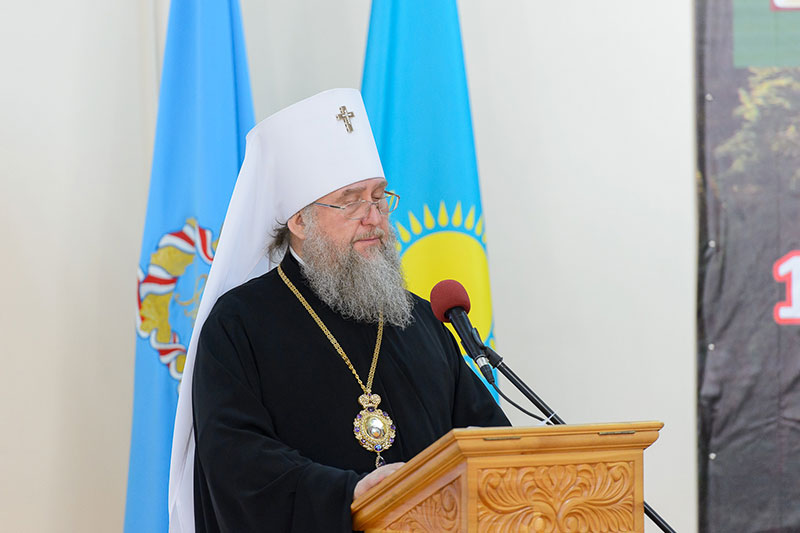
Address by Metropolitan Alexander of Astana and Kazakhstan, Head of the Orthodox Church of Kazakhstan, to the organizers and participants of the Fourth International Scientific and Practical Conference “Theology, Society, State: A Space for Dialogue,” dedicated to the memory of Archbishop Alexander (Timofeyev) of Saratov and Volsk.
Distinguished organizers and participants of the conference!
Your Graces, Most Reverend Fathers, dear brothers and sisters!
The geopolitical challenges and crises in the social and economic spheres facing countries and peoples today demonstrate that human society needs systematic measures to reconsider the role and place of spiritual and moral values, including the development of fundamentally new approaches to relations between religious and secular education. We must foster an intellectual, spiritual, and social environment capable of confidently meeting these challenges.
When we speak of interaction between the Church and society, we mean, first and foremost, the realm of thought and knowledge. It is precisely in this area that cooperation must be strengthened. Unfortunately, there are still many people who have little understanding of what the Church is, what place it occupies in the world, and what its aims and responsibilities are. Such misunderstandings and misconceptions must be addressed by helping people overcome stereotypes concerning faith, religion, sacred traditions, and history. How can these stereotypes be overcome and a genuine, living interest awakened in questions of lasting rather than fleeting significance? Through serious and thoughtful dialogue - intellectual and, at the same time, spiritual.
Religious culture forms the foundation of civilization, for it shapes society’s system of values, meanings, moral norms, and worldview. While material culture - technology, economics, and infrastructure - provides the means for practical survival and comfort, spiritual culture answers the question of why society exists and develops its technologies in the first place.
Theology, as an academic discipline, provides a distinctive forum for interconfessional and interreligious communication, with its own particularly important form of dialogue. Expanding this forum for dialogue serves not only the interests of traditional religious communities but also the direct interests of society and the state.
At the same time, the level and effectiveness of such interaction depend largely on the availability of qualified scholars and theologians who are prepared to engage in this dialogue, participate actively in the life of their religious communities, and enjoy authority and influence within them.
We must recognize that the integration of theology into universities and academic institutions does not contradict the secular character of the state and society, provided that secularism is understood not as aggressive secularism or atheism, but as neutrality toward different worldviews, with due respect for freedom of conscience.
The presence of theology in education and scholarship is a sign of our society’s civic maturity, reflecting its acceptance of its own structural complexity and the many factors shaping it, alongside an awareness of the importance of the spiritual and cultural roots of its civilizational identity.
Christian theology is an essential element of European and Russian culture, as well as the cultures of the Near and Middle East. It ensures that Christian truths and ideas, expressing the religious experience of many generations, remain present in the lives of nations and peoples.
Like any academic discipline, theology is significant not only within its specialized field but also provides a foundation for preserving, enriching, and subsequently transmitting knowledge of broader cultural importance to society at large.
I would like to quote His Holiness Kirill, Patriarch of Moscow and All Rus’: “Theology in higher education, that is, at a high academic level corresponding to the scholarly standards of the humanities and social sciences, is an antidote to the spread of religious radicalism in society, which usually develops spontaneously, without control, and can encompass large numbers of people.”
It is with great satisfaction that I acknowledge the significance of this year’s conference, which has international status and is devoted to the global problems and challenges of our time, as well as to examining the experience of Church-state, interreligious, interethnic, and intercultural dialogue.
I hope that the discussion of these important topics will contribute to the successful resolution of many pressing issues.
I wish all conference participants fruitful work and God’s help in their endeavours.





 Main


Login or register, to write a comment!
Your comment has been successfully added and is currently being reviewed by the site administration