February 1, 2026 – the Sunday of the Publican and the Pharisee, the commemoration day of St. Macarius the Great and St. Mark of Ephesus; the anniversary of the enthronement of His Holiness Patriarch Kirill of Moscow and All Rus’.
On the eve, at the All-Night Vigil, after the reading of the Sunday Gospel, the Lenten troparia were chanted for the first time in the current liturgical year: “Open to me the doors of repentance, O Giver of Life.”
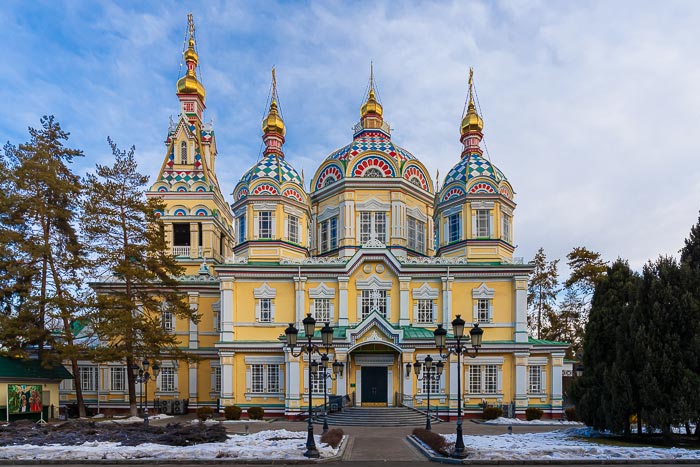
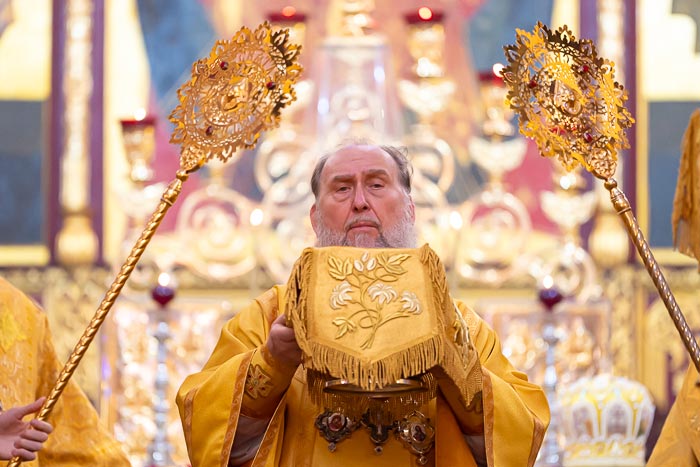
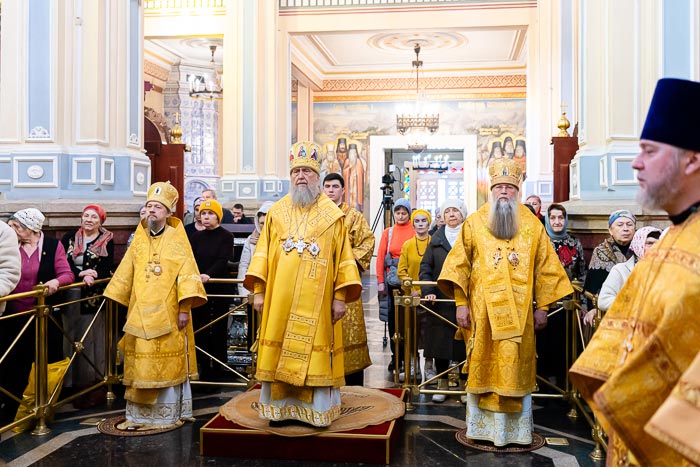
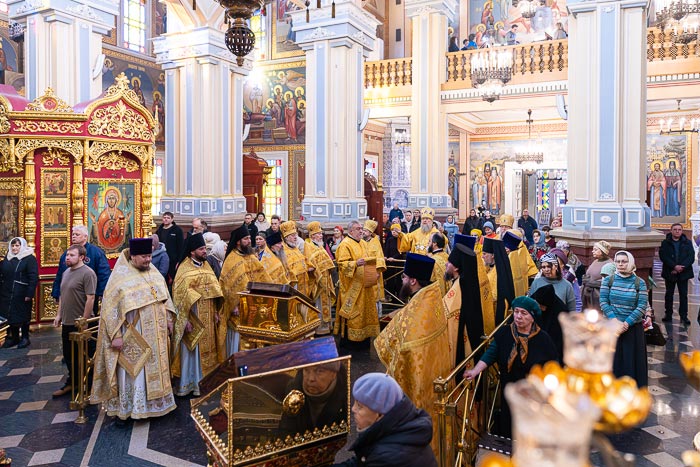
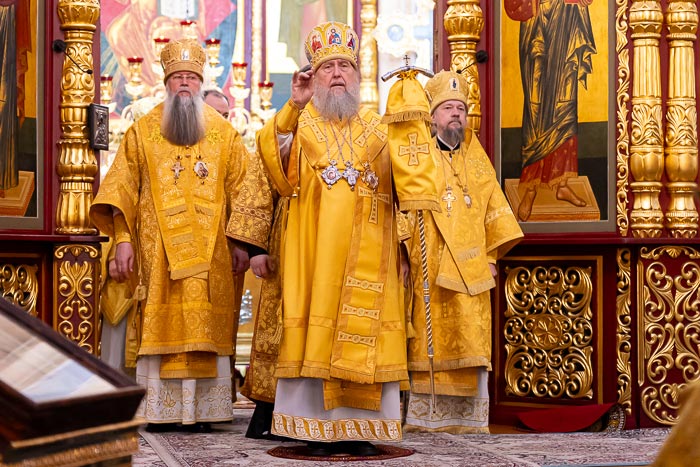
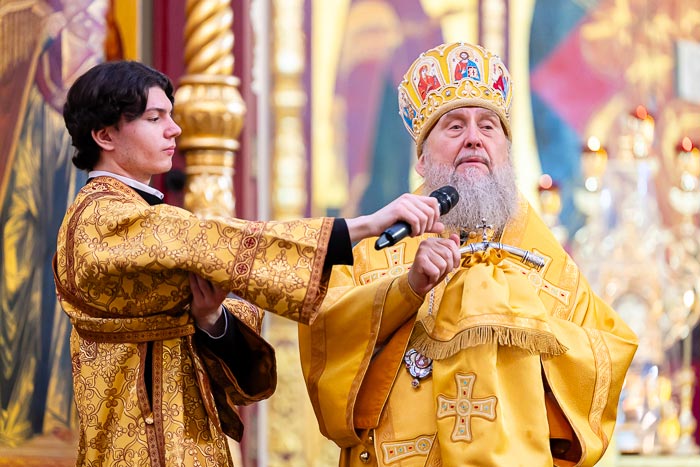
Metropolitan Alexander of Astana and Kazakhstan celebrated the Divine Liturgy at the Ascension Cathedral in the city of Almaty.
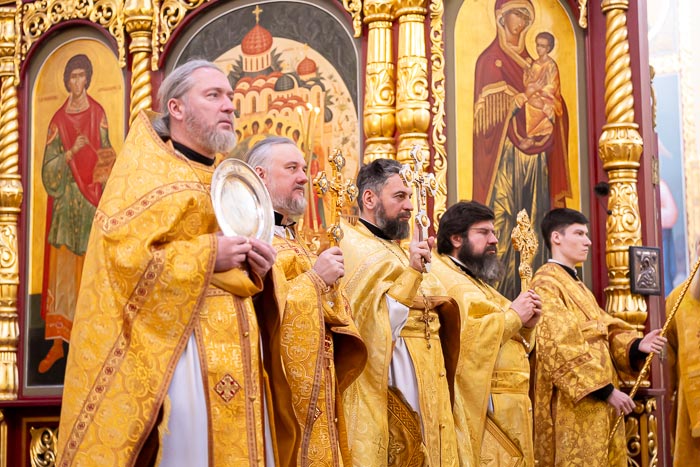
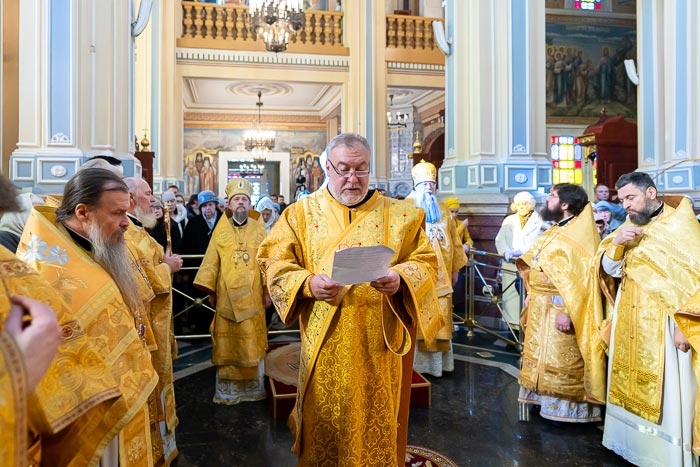
Concelebrating with the Primate of the Orthodox Church of Kazakhstan were: the vicars of the Astana Diocese – Bishop Gennady of Kaskelen, Administrator of the Affairs of the Kazakhstan Metropolitan District, and Bishop Klaudian of Taldykorgan; the dean of the parishes of Almaty, rector of St. Nicholas Cathedral, Candidate of Theology, Mitred Archpriest Valery Zakharov; the dean of the Astana Church District, Archimandrite Sergius (Karamyshev); the rector of the Almaty church dedicated to the icon of the Mother of God “Joy of All Who Sorrow,” Archpriest Evgeny Vorobyov; the dean (kliuchar) of the Ascension Cathedral and head of the Department for Relations with Society of the Metropolitan District, Archpriest Alexander Suvorov; the dean of the Dormition Cathedral in Astana, Hieromonk Dimitry (Baydek); the dean of the Ili Church District, Archpriest Alexander Zyryanov; the dean of the Sts. Peter and Paul Church, Archpriest Kirill Shklyar; Abbot Onisim (Tulnikov); the rector of the Nativity of the Mother of God Church in the Akzhar microdistrict, Hieromonk Alexy (Cherevtsov); head of the Metropolitan’s personal secretariat, Hieromonk Prokhor (Endovitsky); head of the administrative secretariat of the Head of the Metropolitan District, Priest Georgy Sidorov; the dean of the Adrian and Natalia Church, Priest John Konoplev; Protodacon Nikolai Grinkevich; Protodacon Vladimir Syrovatsky; Deacon Vitaly Bystrushkin; Deacon Alexander Piven; Deacon John Zhuchkov; Deacon Georgy Tkachenko.
The liturgical hymns were performed by the choir of the Metropolitan District (regent – Honored Artist of Russia O. N. Ovchinnikov, choirmaster – V. Dudareva) and the choir of the Ascension Cathedral (regent – E. Boguslavets).
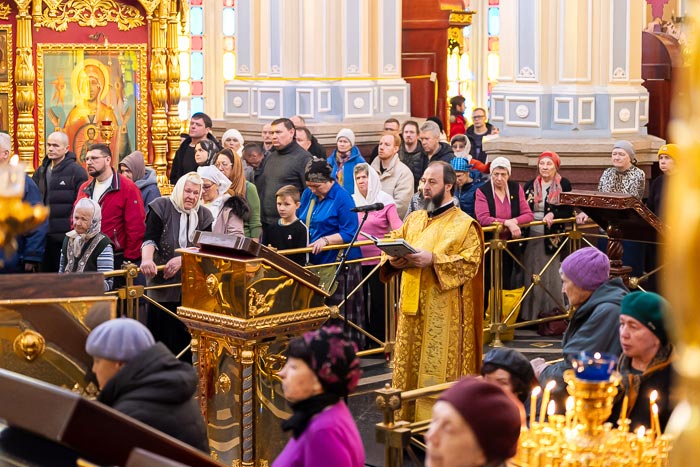
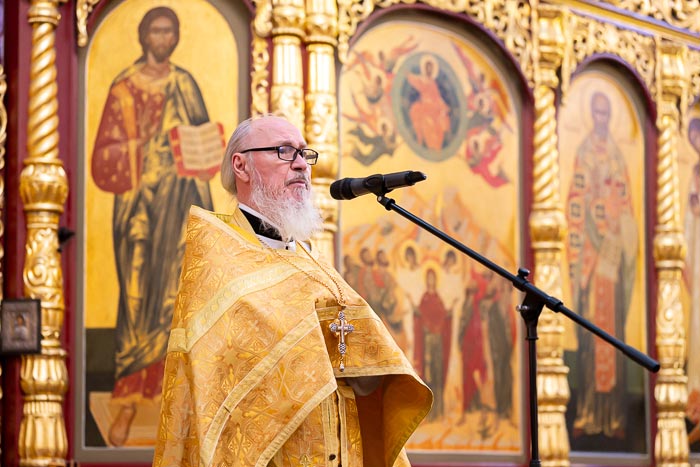
The sermon after the Communion hymn was delivered by Archpriest Valery Zakharov.
At the conclusion of the Liturgy, many years were proclaimed to His Holiness Patriarch Kirill. The clergy, choir, and faithful sang “Many Years” to the Primate.
Metropolitan Alexander congratulated the hierarchs, clergy, and parishioners on the Sunday that opens the preparatory period for Great Lent and on the feast day of St. Macarius the Great, after which he addressed the faithful with a sermon.
A live broadcast of the service was carried out on the YouTube channel “Proobraz,” with the support of the public foundation “Eleos” (director – V. M. Kapsamun).
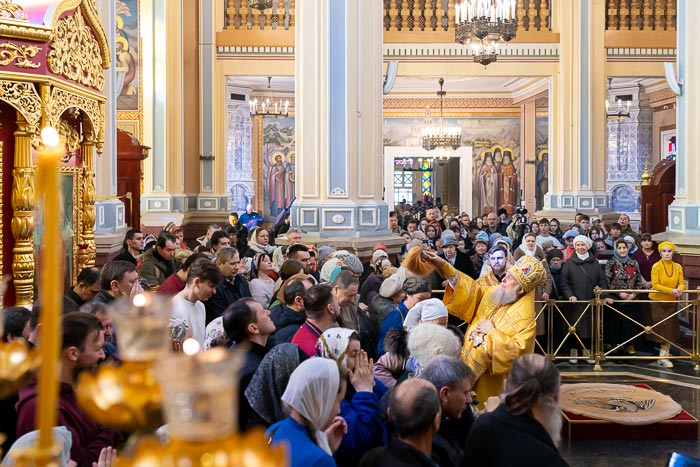
His Eminence sprinkled the faithful with holy water.
“‘Let us not pray like the Pharisee, brethren: for he who exalts himself shall be humbled. Let us humble ourselves before God’ – with this call, sounding in a church hymn, the preparatory period for Great Lent begins for us. Today is the Sunday which, according to the liturgical typikon, is called the ‘Sunday of the Publican and the Pharisee.’ At the Liturgy, the Gospel parable is read about two men – a publican and a Pharisee – who came to pray in the temple. We recalled who the publicans were last week, when we heard the narrative of the Apostle Luke about the meeting of our Lord Jesus Christ with Zacchaeus, the chief publican of the city of Jericho. Today, the Pharisee appears before our spiritual gaze – a man who devoted his life to fulfilling the Law of Moses and zealously observed the commandments. We hear what these people pray for. The Pharisee thanks God that he constantly abides in the performance of good deeds, that he is ‘not like other people,’ while the publican, not daring to raise his eyes to heaven, beats his breast and whispers only one phrase: ‘God, be merciful to me, a sinner!’ The parable concludes with the words that the humble prayer of the publican was pleasing to God: he received forgiveness of his sins, while the Pharisee humbled himself before God by his arrogant and vainglorious prayer. One of the main lessons of this short account is that the Lord is ready to forgive every sinner, no matter how grave his errors and transgressions may be. But the tragedy lies in the fact that often a person does not realize that he is spiritually ill, that his soul is infected with sinful passions; like the Pharisee, he believes that he has done much good in his life, that he is ‘not like other people, robbers, unjust, adulterers.’ For the saving grace of God to be revealed in our lives – cleansing us from sin and directing us toward true virtuous living – it is necessary to humbly acknowledge our guilt before the Lord and, like the Gospel publican, to cry out from the heart: ‘God, be merciful to me, a sinner!’”
From the sermon of Metropolitan Alexander.





 Main
Main



Login or register, to write a comment!
Your comment has been successfully added and is currently being reviewed by the site administration