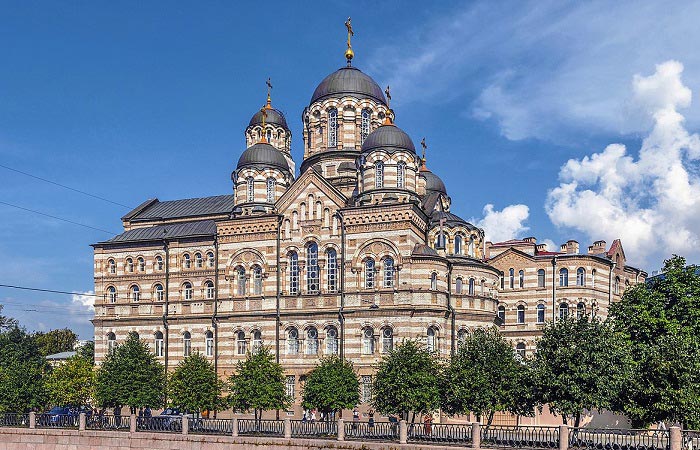
September 4, 2026. St. Petersburg, Russia. Metropolitan Alexander of Astana and Kazakhstan made a pilgrimage to the St. John Stavropegic Convent, where the precious relics of the great saint of God – Righteous Archpriest John of Kronstadt – repose.
His Eminence was accompanied by O.N. Ovchinnikov, Secretary of the Kazakhstan Metropolitan District, Honored Worker of Kazakhstan and Honored Art Worker of Russia, and P.V. Sokolov, Personal Secretary to the Metropolitan.
At the convent, the Primate of the Orthodox Church of Kazakhstan was welcomed by Abbess Lyudmila (Voloshina), Superior of the convent.
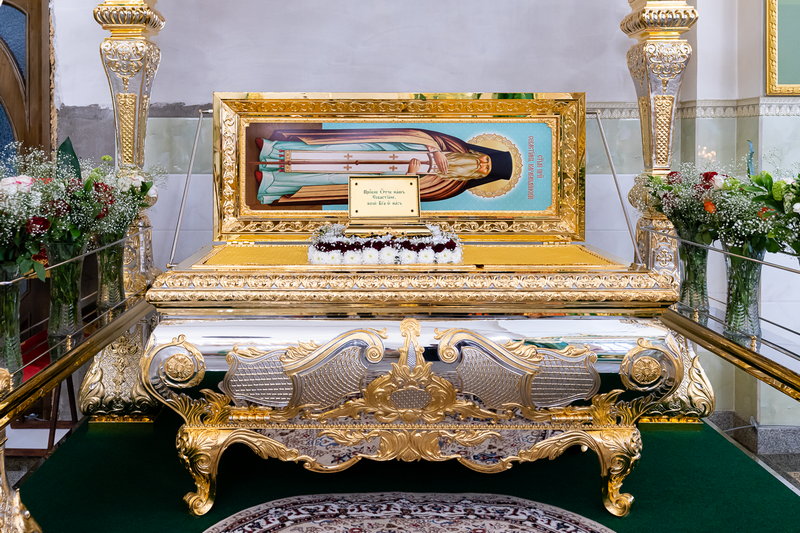
Metropolitan Alexander visited the Church of St. John of Rila and then descended into the crypt, where the relics of Holy Righteous John of Kronstadt repose. The Metropolitan read a prayer to the saint of God and venerated the reliquary containing his holy relics.
The convent on the Karpovka River in St. Petersburg was founded by Holy Righteous John of Kronstadt. Construction began in the spring of 1900 according to a design by architect Nikonov, which had been reviewed by Emperor Nicholas II. By a decree of the Holy Synod in February 1903, the monastery was granted independent status and named the St. John Convent in honor of St. John of Rila, to whom the first church of the monastery, located on the lower floor of the building, was dedicated. In 1924, the convent was officially closed.
Restoration of the convent began in November 1989. On December 25, 1991, the St. John Convent became independent and was granted stavropegic status.
The Head of the Kazakhstan Metropolitan District then visited the Church of the Smolensk Icon of the Mother of God on Vasilyevsky Island and the chapel of one of the most venerated saints in the Orthodox world – Blessed Xenia of St. Petersburg – at Smolensk Cemetery. The chapel was built in 1902 over the burial place of Blessed Xenia. Her grave is located inside the chapel beneath a marble tomb. The grave of Blessed Xenia at Smolensk Cemetery became a place of pilgrimage immediately after her repose at the beginning of the nineteenth century.
Suffering pilgrims came here seeking prayerful help in healing from illnesses and infertility, the gift of family happiness, and many other simple but pressing concerns of everyday life – from work and studies to legal disputes. Pilgrims would take away handfuls of earth from the mound over her grave as a sacred object, and each year the mound had to be restored. A stone slab was placed over it, but even this was gradually chipped away and its fragments carried throughout the world. To preserve the shrine, the first small chapel was erected through public donations as early as the 1830s.
In 1902, a chapel in the Russian Revival style, with a gilded onion dome and stained-glass windows, was built over Mother Xenia’s grave at Smolensk Cemetery according to a design by architect Alexander Alexandrovich Vseslavin. The shrine was closed in 1940. For a time, from February 1947 until 1960, the chapel was reopened to the faithful, after which it was closed once again. It was not until 1983 that it was returned to the community of the Smolensk Church. Following restoration work, the chapel was reconsecrated on August 10, 1987.
At the relics of Righteous Pastor John of Kronstadt and Blessed Mother Xenia of St. Petersburg, Metropolitan Alexander offered special prayers for the episcopate, clergy, monastics and laity of the Kazakhstan Metropolitan District; for the peace and prosperity of the land of Kazakhstan; and for President K.-J.K. Tokayev, the authorities, the armed forces and the people of the Republic.
Following his visits to the holy sites of the city on the Neva, Metropolitan Alexander departed for Moscow.





 Main


Login or register, to write a comment!
Your comment has been successfully added and is currently being reviewed by the site administration