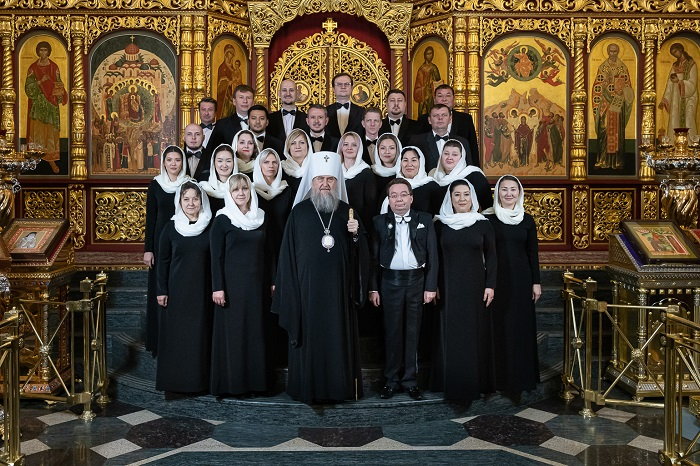
On 16 November 2025, the 23rd Sunday after Pentecost, during the Divine Liturgy celebrated at the Ascension Cathedral in Almaty by Metropolitan Alexander of Astana and Kazakhstan, liturgical hymns set to the music of the great Russian composer Pyotr Ilyich Tchaikovsky were performed by the Metropolitan District Choir.
This year marks a special anniversary – the 185th anniversary of the birth of Pyotr Ilyich Tchaikovsky, one of the world’s greatest composers, a prominent representative of musical Romanticism, and an outstanding master of lyrical and dramatic musical expression.
Since 2010, the Choir of the Kazakhstan Metropolitan District, under the direction of Oleg Nikolaevich Ovchinnikov – Honored Artist of Russia and a member of the Church–Public Council for the Development of Church Singing under the Patriarch of Moscow and All Russia – has performed the Liturgy’s hymns set to Tchaikovsky’s music. The sound of Tchaikovsky’s sacred choral works beneath the vaults of the main churches of Kazakhstan on one of the Sundays closest to the composer’s memorial date has become a cherished cultural tradition in the country.
The creation of a complete cycle of liturgical hymns for the Divine Liturgy of St. John Chrysostom in Tchaikovsky’s musical setting was the first bold attempt by a major secular composer to compose an entirely original musical rendition of the Orthodox service. Tchaikovsky himself admitted that his work was an effort to restore to Russian church music the authenticity forcibly taken from it. In this music, he sought primarily to express his own religious and emotional perception of the service’s key moments. He wrote: “I feel that I am beginning to know how to love God, something I did not know before. I often find inexpressible delight in bowing before the ineffable, yet undoubtedly real for me, Divine Wisdom. I often pray to Him with tears, asking Him to grant me humility and love, asking Him to forgive me, to enlighten me – and above all, it is sweet for me to say to Him: ‘Lord, Thy will be done,’ for I know that His holy will is good.”
Each year, Tchaikovsky’s Liturgy was performed at the Church of the Great Ascension at Nikitskiye Gates in Moscow; this tradition was also maintained in St. Petersburg, at the Alexander Nevsky Lavra, where the composer was buried. Tchaikovsky’s “Liturgy” is rarely performed even as a concert piece. The renowned choir of the Church of the “Joy of All Who Sorrow” icon on Ordynka Street (Moscow), under the direction of N. V. Matveev, revived the old tradition of the Synodal Choir – the annual performance of Tchaikovsky’s work on the anniversary of the composer’s repose.
Being a man of faith, Tchaikovsky attended and deeply loved church services. “I very often attend the Liturgy; the Liturgy of St. John Chrysostom is, in my opinion, one of the greatest artistic creations… Oh, how deeply I love all this; it is one of my greatest delights!” he wrote to his close friend Nadezhda Filaretovna von Meck in 1877.
Between 1878 and 1887, Tchaikovsky turned to the creation of sacred works, composing complete cycles of the most important services of the Orthodox Church – the “Liturgy of St. John Chrysostom” and the “All-Night Vigil”, as well as separate hymns included in the collection “Nine Sacred Pieces” and the Paschal hymn “The Angel Cried”.
The Liturgy was conceived not as a concert piece, but explicitly as part of the church service. Its structure reflects this: it consists of 15 short movements.
The “Liturgy” was completed in May 1878, published and released to the public on 18 January 1879, and was first performed in the church of Kiev University in April 1879. During the composer’s lifetime, this was the only performance within a liturgical context.
“…I want to attempt something for church music,” he wrote. “In this area, a composer has an immense field of activity, one barely touched. I acknowledge certain merits in Bortnyansky, Berezovsky, and others, but how little their music harmonizes with the Byzantine style of architecture and icons, with the entire structure of the Orthodox service!”
Tchaikovsky found both the pompous solemnity of the concert style and the overly sentimental, romance-like emotionality introduced by some composers into sacred works equally distasteful. He believed that the primary qualities of church music should be simplicity, clarity, restraint of expression, and at the same time spiritual warmth and reverent sincerity.
Seeking to avoid concert-like elements that disrupt the austere simplicity of worship, Tchaikovsky entirely omitted solo singing: all hymns are written for full choir, with only brief alternating phrases between women’s and men’s voices in the “Lord, have mercy” responses and the Cherubic Hymn.
Despite this self-imposed restraint, Tchaikovsky’s individual musical signature is unmistakable in the “Liturgy.” Its melodic and intonational language has little in common with the “Byzantine style” he described in his letter, and is instead marked by a deeply personal lyrical character.
Among the most accomplished movements of the work is the Cherubic Hymn, with its gently restrained, chaste lyricism and vibrant contrasts between choral groups.
There are also other, perhaps unintentional, intonational correspondences between different movements of the “Liturgy,” giving it a sense of musical unity and structural coherence.
The Liturgy of St. John Chrysostom follows directly after Tchaikovsky’s major works of the late 1870s – the Fourth Symphony and Eugene Onegin.
The composer believed that a return to ancient chant traditions and the use of old liturgical melodies would be most suitable for Orthodox worship. Realizing that such a radical shift could not occur immediately, Tchaikovsky considered his own works a “transitional step.” In the Liturgy of St. John Chrysostom he did not quote traditional chants, yet his music contains clear intonational echoes of them.
In 2015, after the Divine Liturgy at the Cathedral of Christ the Savior in Moscow, at which Tchaikovsky’s “Liturgy” was sung, His Holiness Patriarch Kirill said in his address to the congregation: “Inspiration is the ability to receive the signal that God sends to a person, and Pyotr Ilyich Tchaikovsky was one who received this gift.”





 Main
Main


Login or register, to write a comment!
Your comment has been successfully added and is currently being reviewed by the site administration