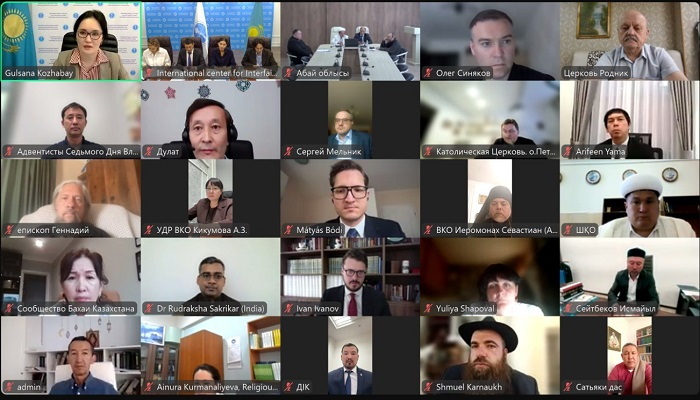
June 1, 2026. Astana. An international online conference entitled “The Role of Religious Leaders in Achieving the Sustainable Development of Peace” took place at the International Center for Interfaith and Interreligious Dialogue of the Republic of Kazakhstan.
The event brought together leaders of world and traditional religions, representatives of the academic and expert community, and government authorities.
Among the topics discussed was the influence of new information technologies and artificial intelligence on the processes of interreligious interaction.
With the blessing of Metropolitan Alexander of Astana and Kazakhstan, Bishop Gennady of Kaskelen, Chancellor of the Kazakhstan Metropolitan District, delivered a presentation at the conference:
Dear participants of the conference!
The Eighth Congress of Leaders of World and Traditional Religions, held in Astana in September 2025, opened a new stage of cooperation among representatives of different religions in strengthening mutual trust and the spiritual security of society. We value the efforts of state authorities in various countries aimed at seeking conditions for the harmonization of interreligious relations. Kazakhstan makes an invaluable contribution to the cause of interreligious peace and concord. Much effort in this direction is made personally by the President of our Republic, K.-J.K. Tokayev.
At the same time, we recognize how much in this matter depends upon the leaders of religious organizations. The most important condition for deep interconfessional harmony is the coordinated position of religious leaders and authoritative theologians. We must declare an uncompromising struggle against religious intolerance, extremism under the banner of faith, and affirm a spirit of mutual respect and tolerance toward representatives of other religions. Much has been said about this at all the traditional forums.
At the most recent Interreligious Forum, for the first time, so much attention was devoted to new challenges connected with the introduction of new information technologies and artificial intelligence. Indeed, this is a very important and compelling issue. It requires serious reflection.
We often underestimate the seriousness of the problem. There exists a superficial perspective: that all human inventions are merely tools, and that it depends on the individual whether they are used for good or evil. Yet as early as the 1950s, the distinguished philosopher Martin Heidegger perceptively observed that technology is not merely a simple instrument for the achievement of human goals. Moreover, it is precisely the recognition of technical means as neutral that increases humanity’s dependence upon technological progress. We find ourselves in a truly dangerous captivity to technology.
The process of technological advancement changes the nature of the world around us. Human beings begin to look upon the world through entirely different eyes, and through this, humanity itself undergoes radical transformation.
Whereas in the past technological inventions complemented natural landscapes, today we increasingly perceive nature and the whole surrounding world as an adjunct to our own technological creations. Technology forms a new type of thinking, an entirely new culture, and new patterns of behavior. All these processes require attentive, sober analysis and reflection on the part of religious leaders. We must answer the question: how dangerous are the ongoing changes for healthy religious life and for human nature itself? It seems that, in the effort to comprehend these matters, representatives of traditional religions may in many respects harmonize their positions.
In the fundamental document of the Russian Orthodox Church, The Basis of the Social Concept of the Russian Orthodox Church, the following principle is formulated: new technologies must not subordinate the human person. The creation of systems that encroach upon human freedom and dignity is inadmissible.
Among the dangers posed by new information technologies, specialists identify the following threats. The autonomy of the individual is called into question. Emerging systems of behavioral prediction, social rating mechanisms, and manipulation of consciousness through personalized content limit human freedom. Labor becomes dehumanized. Human interaction is replaced by algorithms. The profound meaning of human activity is lost.
A grave challenge is connected with the military application of artificial intelligence. Autonomous systems independently decide whether to strike a target, whether to take human life or not.
The capacity for human communication is being lost. This is particularly noticeable among contemporary youth. His Holiness Patriarch Kirill has observed: “If the bond between one person and another is severed, society degrades or even disappears… What kind of world will people inhabit if they lose the ability to communicate with one another, and therefore the ability to love, forgive, and show compassion?”
The Orthodox Church of Kazakhstan consistently supports the efforts of the state aimed at strengthening peace and stability in a multi-confessional society. At the same time, we are convinced that the constructive potential of traditional religions in the Republic is far from exhausted, and that the development of state-confessional relations must be given renewed impetus.
I am convinced that religious leaders of various confessions will continue to make a substantial contribution to the progressive development of our country and of the whole world.





 Main
Main


Login or register, to write a comment!
Your comment has been successfully added and is currently being reviewed by the site administration