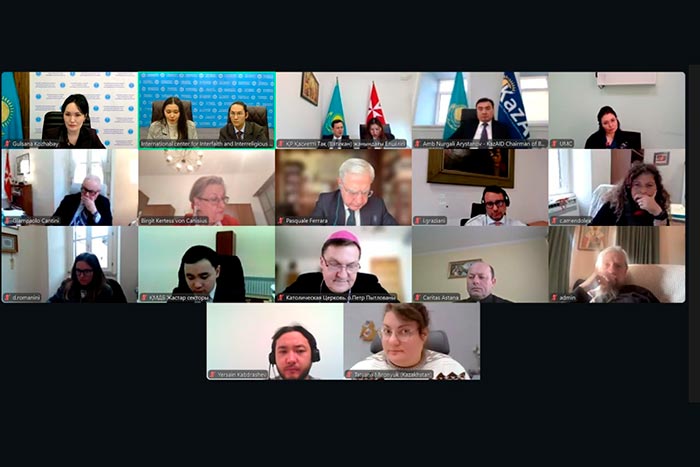
On November 17, 2026, the international round table “Interreligious and Humanitarian Cooperation within the Framework of the Congress of Leaders of World and Traditional Religions” was held in Astana.
The event was organised by the International Centre for Interfaith and Interreligious Dialogue jointly with the Sovereign Order of Malta, with the assistance of the Embassy of the Republic of Kazakhstan to the Holy See and the Sovereign Order of Malta.
With the blessing of Metropolitan Alexander of Astana and Kazakhstan, Bishop Gennady of Kaskelen, Vicar of the Astana Diocese, participated in the round table, which was held in the format of a videoconference.
The meeting was attended by Giampaolo Cantini, Secretary General for Foreign Affairs of the Sovereign Order of Malta; representatives of Kazakhstan’s governmental institutions, KazAID, the Red Crescent Society, University Medical Center, Caritas, UNICEF Zhastary and the National Volunteer Network, as well as representatives of the diplomatic corps, religious associations, international humanitarian organisations, the medical community and youth volunteer movements.
In her welcoming address, Gulsana Kozhabay, Chairperson of the Board of the International Centre, noted that the International Centre and the Sovereign Order of Malta, while working in different fields, are united by a common mission. The International Centre strengthens peace and mutual understanding through interreligious dialogue, while the Order of Malta has embodied the principles of mercy through humanitarian assistance for more than nine centuries.
Particular attention was devoted to the practical implementation of the decisions of the XXIV Meeting of the Secretariat of the Congress, held on October 7, 2026, under the chairmanship of Vice-President of Kazakhstan Erlan Karin. In particular, two documents were presented: “The Code of Ethics for the Use of Artificial Intelligence in the Religious Sphere” and “The Role of Religions in Combating Climate Change”. The humanitarian agenda was complemented by the “Charter of the Rights of the Child with an Incurable Illness”, developed in cooperation with the Holy See.
In this context, particular significance was attached to the international experience of the Sovereign Order of Malta in the provision of medical and social assistance, as well as to the activities of the Bambino Gesù Children’s Hospital and medical organisations in Kazakhstan.
Giampaolo Cantini, Secretary General for Foreign Affairs of the Sovereign Order of Malta, presented the principal areas of the organisation’s activities, noting that for more than nine centuries the Order has provided medical, social and humanitarian assistance to those in need, regardless of their origin or religious affiliation. Today, its activities encompass 130 countries and include support for vulnerable groups of the population, assistance to refugees and victims of armed conflicts and natural disasters.
Special attention was devoted to the humanitarian consequences of climate change. The participants considered issues relating to emergency response, the provision of assistance to affected populations, and the training of volunteers to work in humanitarian crises. These areas of activity are consistent with the provisions of the Congress document “The Role of Religions in Combating Climate Change”, which envisages greater involvement of religious communities in addressing environmental problems.
“I cordially greet the organisers and participants of the round table on the theme ‘Interreligious and Humanitarian Cooperation within the Framework of the Congress of Leaders of World and Traditional Religions’. We are witnessing the implementation of the decisions of the VIII Congress of Leaders of World and Traditional Religions, held in October 2025. The 2025 Astana Peace Declaration adopted at the forum pointed to the need for the responsible use of new technologies, including digital technologies, artificial intelligence and bioengineering. It emphasised that, despite advances in the development of artificial intelligence, the capacity for genuine compassion and love remains a uniquely human characteristic, and that the cultivation of these qualities should form the foundation of the humanistic, spiritual and moral development of humanity. The ideas expressed formed the basis of the ‘Charter of the Rights of the Child with an Incurable Illness’, adopted at the meeting of the Secretariat of the Congress in October 2026.
Of particular significance for representatives of traditional religions is Article 9 of the Charter, which states: ‘The child and his or her family also have the right to receive information about available spiritual support. At the voluntary request of the child and/or his or her family, the healthcare institution shall facilitate the provision of spiritual support, where such support is available. To this end, the healthcare institution may invite a spiritual mentor, a clergyman or another person to provide spiritual accompaniment to the child and his or her family, taking into account their religious beliefs or worldview and in compliance with national legislation and the internal regulations of the healthcare institution.’
From the perspective of the Orthodox Church, concern for bodily health is not an absolute and self-sufficient goal for man. ‘Is not the life more than meat?’ (Matthew 6:25), asks the Lord Jesus Christ. Elsewhere in the Gospel, the Saviour says: ‘For what shall it profit a man, if he shall gain the whole world, and lose his own soul?’ (Mark 8:36). According to Orthodox teaching, man consists of an immortal soul and a mortal body. Bodily health is therefore only one aspect of the entirety of human existence. ‘The Basis of the Social Concept of the Russian Orthodox Church’ emphasises that ‘the Church’s activity in the sphere of healthcare is aimed at imparting the grace of the Holy Spirit to those who suffer. The principal place in this activity is occupied by participation in the saving Sacraments of the Church, the creation of a prayerful atmosphere in medical institutions, and the provision of various forms of charitable assistance to their patients.’
In exercising pastoral care for sick children, the clergy of the Orthodox Church of Kazakhstan are guided by the principles set forth in ‘The Basis of the Social Concept’. This ministry is carried out in social institutions operating under the auspices of the Church, particularly at the ‘Solnyshko’ (‘Little Sun’) Children’s Home in the Almaty Region, as well as through medical sisterhoods established in many dioceses and in hospices, including children’s hospices, where our clergy also labour. Children suffering from incurable illnesses undoubtedly need qualified palliative care provided by medical professionals.
However, it is no less important to help a child comprehend the profound religious meaning of suffering, which, in my conviction, can be fully revealed precisely from a religious perspective. When a person understands that his suffering has meaning, it becomes easier for him to endure trials, sometimes even with joy. There is nothing more grievous than to suffer with a sense of the meaninglessness and hopelessness of one’s own torment. Such a state may be likened to hell. The Austrian psychiatrist and philosopher Viktor Frankl described a similar state using the concept of the ‘existential vacuum’. He regarded the loss of traditions, primarily religious ones, as one of the causes of its emergence.
In Christianity, the meaning of suffering is revealed, in particular, in the words of the Apostle Paul from his Second Epistle to the Corinthians: ‘For as the sufferings of Christ abound in us, so our consolation also aboundeth by Christ’ (2 Corinthians 1:5). A priest or a Christian physician can tell a child suffering from an incurable illness about the redeeming sacrifice of the Lord Jesus Christ and endeavour to awaken in the child’s heart a love for the Saviour. Contemplation of Christ’s sufferings can in itself become a source of spiritual consolation for those who love the Lord. For we know that sharing the fate of a loved one, even when that fate entails grievous trials, may be perceived not only as suffering but also as an expression of love and spiritual closeness. In conclusion, I would like to express my hope for the further development of humanitarian cooperation between representatives of different religions under the auspices of the Congress of Leaders of World and Traditional Religions,” Bishop Gennady of Kaskelen noted, in particular, in his report.
One of the central topics of discussion was the exchange of experience within the international volunteer movement. Representatives of religious and youth associations considered opportunities for the joint training of volunteers, the implementation of educational initiatives and the exchange of experience in humanitarian activities.
The Head of the UNICEF Zhastary national volunteer programme presented the results of the volunteers’ activities: 20,000 trees had been planted, and more than 700 tonnes of waste had been collected and sent for recycling. He devoted particular attention to the participants’ own satisfaction with their volunteer activities, which stood at 98.5 per cent. Tatyana Mironyuk, Executive Director of the Association of Legal Entities “National Volunteer Network”, expressed interest in cooperation with the Order of Malta in the education and training of volunteers and volunteer coordinators to work in emergency situations. She noted that international organisations employ different response protocols and emphasised the importance of exchanging experience and coordinating approaches so that volunteers could act promptly and professionally in crisis situations.
At the conclusion of the round table, the participants identified promising areas for further cooperation, including exchanges of expertise, educational programmes and the development of joint initiatives in the provision of medical, social and humanitarian assistance.
Administrator of the Metropolitan District Participates in the Round Table “Interreligious and Humanitarian Cooperation within the Framework of the Congress of Leaders of World and Traditional Religions”
More details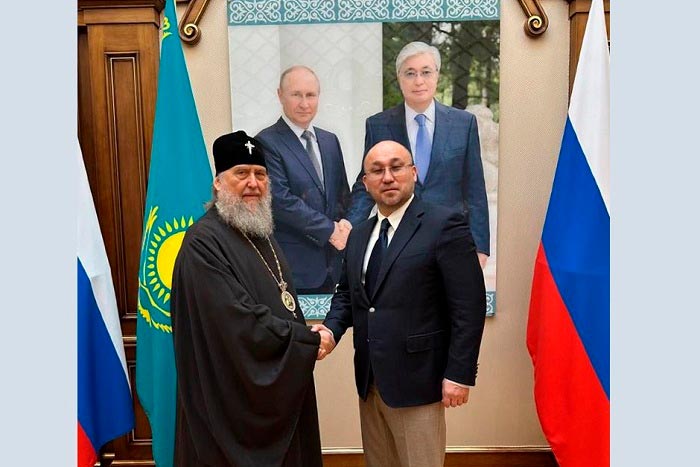
Head of the Metropolitan District of Kazakhstan Meets with Dauren Abayev, Ambassador of Kazakhstan to Russia
More details
On the Feast Day of St. Tikhon, Patriarch of All Russia, Metropolitan Alexander Celebrates the Divine Liturgy at the Church of the Representation of the Metropolitan District of Kazakhstan in Moscow
More details



 Main


Login or register, to write a comment!
Your comment has been successfully added and is currently being reviewed by the site administration