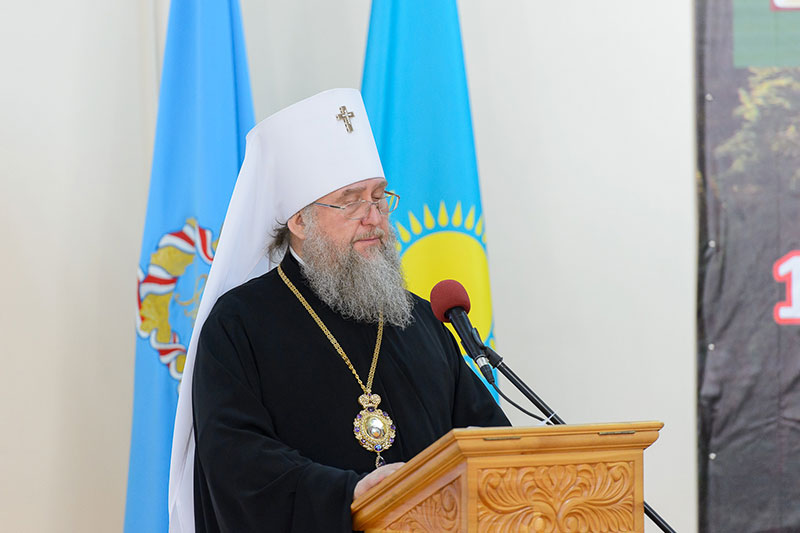
August 10, 2026. Kostanay. The 5th International Scientific and Theological Conference “Timon Readings” is being held in Kostanay. The Head of the Orthodox Church of Kazakhstan, Metropolitan Alexander of Astana and Kazakhstan, sent the following greeting to the organizers and participants of the forum:
Reverend Fathers, dear brothers and sisters!
I greet the organizers and participants of the 5th International Scientific and Practical Conference “Timon Readings.”
In 2026, several parishes of the Kostanay Diocese are marking the 80th anniversary of their revival after a time of fiery trial (1 Pet. 4:12) – several decades of desecration and destruction. By the beginning of the Great Patriotic War, the state of Orthodoxy in the Kazakh SSR was truly tragic – of more than 150 pre-revolutionary parishes, not a single one remained where divine services were held regularly. All churches had been closed. The last church – the cemetery Church of Saints Cosmas and Damian in Kustanay – was closed in 1938. The authorities’ anti-religious policies deprived the clergy who remained in the region of the opportunity to celebrate divine services openly, and many pastors were subjected to repression.
A turning point in the life of the entire Russian Orthodox Church came at the height of the war, on September 4, 1943, when Metropolitans Sergius (Stragorodsky), Alexy (Simansky), and Nicholas (Yarushevich) met with the head of the Soviet government, I.V. Stalin. This event led to changes in relations between the state and the Church, as a result of which the faithful received, albeit for only a very brief period, a respite from repression and overt persecution.
In 1945, the Alma-Ata Diocese resumed its activities, encompassing the parishes located in the Kustanay Region of the Republic. The diocese was headed by the 68-year-old hierarch and confessor Nicholas (Mogilevsky), Metropolitan of Alma-Ata and Kazakhstan, who had been released after many years of exile. He devoted all his strength to restoring normal church life in the region, undertaking everything that was possible under the difficult conditions of the postwar years.
In 1945–1946, the faithful were permitted to open houses of prayer. Since all church buildings closed in the 1920s and 1930s had either been destroyed or repurposed for public use, Orthodox Christians were compelled to establish places of worship in converted residential houses or outbuildings. The authorities returned only one historic church – the Church of Saints Constantine and Helen in Kustanay. It would remain the only functioning church in the region during the anti-religious campaign of the Khrushchev era.
The past is not a museum, but the foundation of our tomorrow. By studying history, we build the future. Memory, in the words of Academician D.S. Likhachev, “opposes the destructive power of time and overcomes time itself.” Yet memory does not exist in isolation, apart from the living spiritual experience of generations. When it loses its connection with spiritual tradition, it gradually fades and dies away.
The preservation of historical memory is one of the most pressing issues facing contemporary society. Memory – personal and familial, as well as the memory of a people as a whole – not only shapes who we are today, but also largely determines the direction in which we will build our future. In circumstances where people, especially the younger generation, are subjected to various forms of media influence, including those aimed at making them forget their own roots or imposing distorted ideas about the past, the task of preserving authentic historical memory and ensuring that the traditions of a people remain alive and take root in future generations acquires genuine and vital importance.
The Kostanay Region possesses a rich and fascinating history, including a significant ecclesiastical history. Much of its former appearance has now been lost, while the memory of destroyed churches and monasteries is accessible only to a narrow circle of local historians and scholars specializing in this field. Society and, to our particular regret, the younger generation know little about the history of their city and region, have a poor grasp of important dates, and do not fully appreciate the significance of the historical processes that unfolded in their native land.
One of the important tasks before us is therefore to draw the attention of broad sections of society, and especially young people, to the preservation of historical memory and cultural heritage embodied in monuments of architecture, iconography, and works of fine art. We can and must bear witness to the fact that Christianity gave the world not only ecclesiastical culture, but also became a source of high secular culture. The distinguished philosopher Nikolai Berdyaev expressed this profoundly and succinctly: “Culture is connected with cult; it develops from religious cult and is the result of the differentiation of cult, the unfolding of its content in different directions. Philosophical thought, scientific knowledge, architecture, painting, sculpture, music, poetry, morality – all are organically contained in their entirety within ecclesiastical cult, in a form not yet unfolded or differentiated.”
It is noteworthy that in 2026 the now traditional Timon Readings are being held on August 10. His Grace Bishop Timon (Rusanov) – a pillar of faith and piety, a fighter against atheism and schism, a fearless preacher of the truth of God and denouncer of unbelief – undoubtedly occupies an outstanding place among the hierarchs of the Church of Christ in the twentieth century. He carried out his episcopal ministry during a time of severe trials.
Exactly 101 years ago, on August 10, 1925, his episcopal consecration took place, marking the beginning of the final period of his confessional ministry. Every year, the Timon Readings bring together participants not only from the dioceses of Kazakhstan but also from abroad. This is our contribution to preserving his memory and a tribute to his spiritual and educational labors.
We are able to bear the light of the Gospel, build churches, and establish communities upon the good soil cultivated through the labors and prayers of our devout forebears, ascetics, martyrs, and confessors. This is why events such as today’s conference are so important: they bring the history of Orthodoxy to life in our memory and preserve it in tangible works – books, collections of conference papers, journals, and almanacs. This is our modest contribution to the education of the younger generation of Orthodox Christians. It is also an expression of profound reverence for the sacred pages of the past and for our spiritual fathers, enlighteners, mentors, and ascetics.
I wish the organizers and participants of the Timon Readings fruitful and successful work.




 Main
Main


Login or register, to write a comment!
Your comment has been successfully added and is currently being reviewed by the site administration