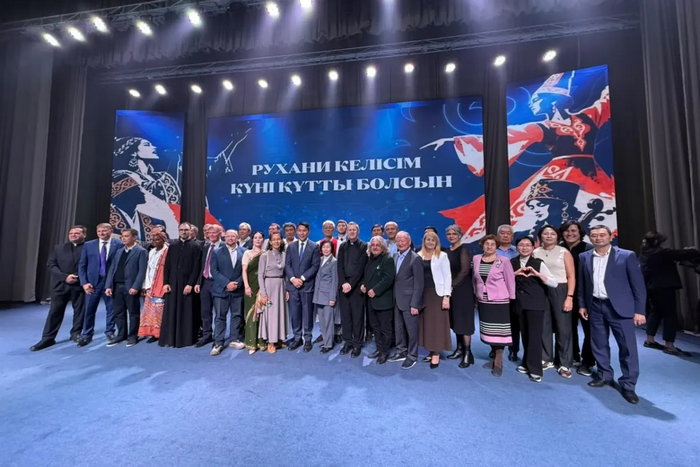
On May 15–17, 2026, with the blessing of His Holiness Patriarch Kirill of Moscow and All Rus’, the international festival – choral assembly Paschal Hymn took place in Alma-Ata.
As part of the theoretical section, presentations were delivered by members of the Patriarchal Council for the Development of Russian Church Singing.
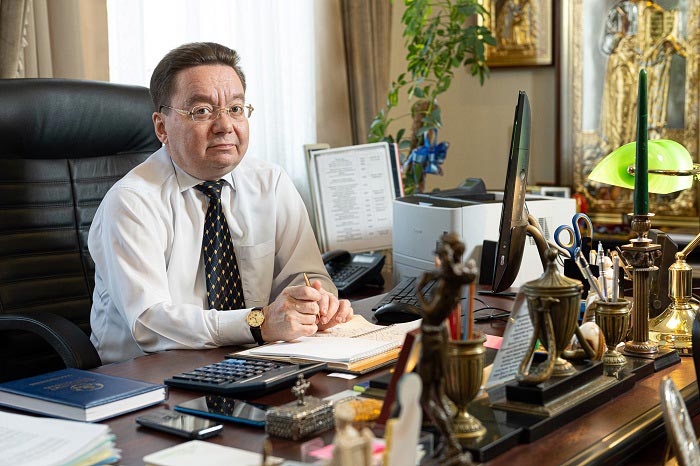
We offer to the attention of visitors to our website the presentation by O.N. Ovchinnikov, Choir Director of the Choir of the Kazakhstan Metropolitan District, Honored Worker of Kazakhstan and Honored Artist of Russia:
Most Reverend fathers, brothers and sisters!
We live and labor in a unique time, when the church choir director has at his disposal a multitude of chants differing in style, historical period, and degree of difficulty. With the development of the internet, the acceleration of information exchange, and the evolution of interpersonal communication, anyone who wishes can find the score of virtually any composition. All of this has led to the accumulation of a “critical mass” of material. On the one hand, such extraordinary diversity and breadth of choice can only be welcomed, yet on the other hand, we see the emergence – or rather the intensification – of a number of problems. I shall mention those which, in my view, are the most significant:
– the absence of criteria according to which kliros repertoire is formed;
– repertory eclecticism, that is, the use within one service of works from different periods, styles, chant traditions, and composers;
– the training of the choir director and singers, enabling them to select repertoire appropriately and to perform the chosen material competently and with quality.
Let us examine these questions in greater detail. Almost everywhere, one observes a tendency toward genre and historical eclecticism. For performance during divine services, the choir director selects chants composed by different authors, in different periods, and in differing styles. Such an approach to repertoire frequently distorts the perception of the inner structure of the service as an integrated whole. The parts of the All-Night Vigil or the Divine Liturgy lose their logical connection with one another, and the person praying in church involuntarily begins to perceive the choir’s performance as a sequence of separate concert pieces. Practice shows that, alongside works genuinely ecclesial in spirit, music of not the highest aesthetic merit is also heard on the kliros.
Is eclecticism in the selection of chants permissible? Undoubtedly, it is permissible and, objectively speaking, inevitable. The preservation of eclecticism makes it possible to impart contour, artistic richness, and depth to divine worship. Melodic unity should not be achieved at the expense of narrowing or impoverishing the repertoire. The Divine Liturgy and the All-Night Vigil may include very diverse compositions, but what is essential is semantic, musical, and tonal unity.
At the same time, the principal criteria for selecting a work should be its correspondence to the liturgical and theological essence of a particular church service and its musical and aesthetic compatibility. The selection of chants requires from the choir director careful attention to liturgical theology, a strong knowledge of church singing repertoire, and broad musical horizons.
The taste of a choir director performing music rooted in the Western European cultural tradition should be refined through thoughtful and careful acquaintance with that very tradition: through the ability to understand operatic art and the secular choral tradition of the sixteenth–twentieth centuries. And as an indispensable condition – the ability to hear and understand the Byzantine and Russian, znamenny singing tradition, regardless of the choir’s repertoire.
The outstanding thinker and philosopher V.N. Lossky said: “Music, perhaps more than other forms of art, creates a certain difficulty in that it is largely subject to tastes.” Leaders of choral ensembles and performers alike must cultivate a taste for genuinely ecclesiastical singing, a love for tradition, and delicacy and sensitivity toward the rich musical heritage of our Church.
As His Holiness Patriarch Kirill said: “What has come down to us from history should not be broken.” There exists an area within church singing where everything has already been completed and brought to fulfillment, where the talent of a composer is no longer required, but only the mastery of the choir director. And the principal task of the specialist, in my opinion, is to feel and understand this.
The richness of melodies and chant traditions grants considerable freedom for the creativity of choirs and for the realization of the potential of choir directors and singers. Yet, when used improperly, it may transform divine worship into a series of concert performances or, through its unusualness and at times exotic character, trouble the minds and hearts of parishioners raised within certain established traditions.
Imagine an ordinary parish church, Matins of Great and Holy Saturday, and the singing of the troparia The Noble Joseph… And instead of the familiar “Bulgarian Chant,” something entirely different begins to sound, even if quite pleasant to the ear. The same applies to the irmoi Helper and Protector or By the Wave of the Sea, the stichera of Holy Pascha, and many texts of the Triodion and the Great Feasts. What would be the reaction of the overwhelming majority of parishioners? Most likely, a negative one.
There are such works, chant traditions, and melodies that have become an organic and inseparable part of the liturgical tradition of Russian Orthodoxy. In my view, it is inadmissible to abandon the Octoechos in the existing and familiar forms that took shape in nineteenth-century Saint Petersburg and Moscow. Traditionalism, which in secular music may be regarded as triviality, in liturgical music, on the contrary, becomes a necessary quality.
As concerns the singing repertoire itself, there are likewise several points to which attention must be paid. One of the problems of a considerable number of choirs is an unwillingness to renew the repertoire. Week after week, year after year, works by the same authors are performed. The opposite extreme is the pursuit of novelty, an intense desire, if not for every Sunday, then certainly for every major feast, to learn (usually in haste) two or three new works. An experienced choir director must allow neither the first nor the second extreme.
The repertoire must indeed be renewed, but one should not attempt to master, at an accelerated pace, everything offered by newly published collections of church music. Until one Cherubic Hymn or Mercy of Peace has been fully worked through with the choir, another should not be undertaken.
A serious mistake in the work of a choir director is the phenomenon whereby the choir leader gives careful attention to chants of the central, key moments of the service, while treating secondary (in his personal opinion) moments with neglect. Thus, for example, after a carefully prepared and beautifully performed O Gladsome Light, there suddenly follows a completely unrehearsed prokeimenon, or the augmented litany sounds careless and untidy. Instantly, not only is the unified impression of the divine service destroyed, but the positive perception of the spiritual music previously heard also disappears. Here the principle applies: a drop of tar spoils a barrel of honey.
Unfortunately, the greatest victims of this phenomenon are the “variable” hymns – the texts of the Octoechos, the Triodion, and the Menaion. Irmoi, troparia, and stichera require a solid knowledge of the tones, an ability to read the text meaningfully, placing the correct semantic emphasis. In the absence of professionalism, stichera turn into monotonous, off-key, or mechanical shouting or mumbling, whereas it is precisely in them that the principal theological, liturgical, and moral instruction is contained.
The performance of “variable” hymns, despite their seeming simplicity, requires from the choir director the same careful preparation with the choir as a Cherubic Hymn or a Communion concert.
Alongside the problems of repertoire formation, the choir director always faces the question of how a particular chant ought properly to sound, whether the ensemble in its present composition will be able to perform the work competently, and what the nuances should be – tempo, volume, tessitura. The most widespread mistake, in my opinion, is the mismatch between a work and the characteristics and abilities of the choir. And this is not always a matter of lack of professionalism.
For example, a choir may consist of eight people with musical education and good vocal abilities, and suddenly the choir director decides to perform works by P. Tchaikovsky, D. Bortnyansky, A. Vedel, or S. Rachmaninoff, whose musical texture was intended for a large choir of more than twenty singers. As practice shows, the result will be meager, restless, and strained singing, far removed from churchly reverence.
Before proposing a chant for study and incorporation into the repertoire, the choir director must have a clear understanding of the type of ensemble for which the composer wrote, what performance characteristics were intended in the original conception, and it is important soberly and objectively to assess the capabilities of one’s choir, avoiding unjustified ambitions. The size and professional preparation of a particular choir must certainly be taken into account when selecting works.
It is better to sing something simple and “customary” with quality, precision, and unity than unpleasantly to surprise the faithful with musical experiments.
It is impossible to provide a list of compositions approved for liturgical use, because their number is enormous. Yet every choir director can and should compile a library for his choir. But how should these works be selected? Here one must take into account the professional level of the singers, the architectural features of the church, its interior, the history of the parish, and the disposition of the faithful at prayer.
We, choir directors, must refine not only our professional mastery, but also cultivate and polish our taste through thoughtful and careful acquaintance with works of sacred music of different styles, periods, and genres. We must understand secular choral and operatic art, Byzantine and Russian singing, as well as domestic and Western European classical traditions.
It is necessary to exercise caution in preferences toward particular chant traditions or composers, when declaring something canonical and truly spiritual while dismissing something else as non-ecclesiastical. The question cannot be posed in such a way that one composer may be sung while another may not. Every work must be considered independently of the author’s name, on its own merits. The name of a genius must not overshadow the content.
Even among the most renowned church composers, one may identify works that are frankly weak in liturgical terms, while among lesser-known composers one sometimes encounters genuine works of art.
There is also such a phenomenon whereby the choir director and ensemble desire to improvise in the choice of chants, to perform sacred music of unfamiliar sound, or to sing works by contemporary composers, while the clergy and parishioners wish to hear melodies and chants familiar to them. The choir is not separate from parish and liturgical life, and conflicts arising from sacred music are inadmissible.
Liturgical singing must unite parishioners, the kliros, and the clergy, rather than become a source of discord. A possible solution may be the performance of such unusual works outside the divine services – in a concert setting. This would allow the choir to realize its aspirations while introducing people of varying degrees of church involvement to the richness and diversity of sacred music.
In conclusion, allow me to wish all of us fruitful work, blessed success, and creative inspiration!
Thank you for your attention!
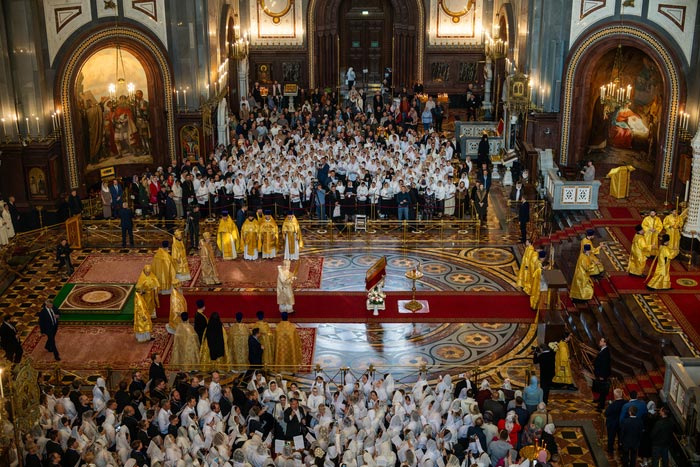
O. N. Ovchinnikov, choirmaster of the Kazakhstan Metropolitan District, took part in a patriarchal divine service held at the conclusion of the IV International Congress of Choirmasters and Singers of the Russian Orthodox Church.
More details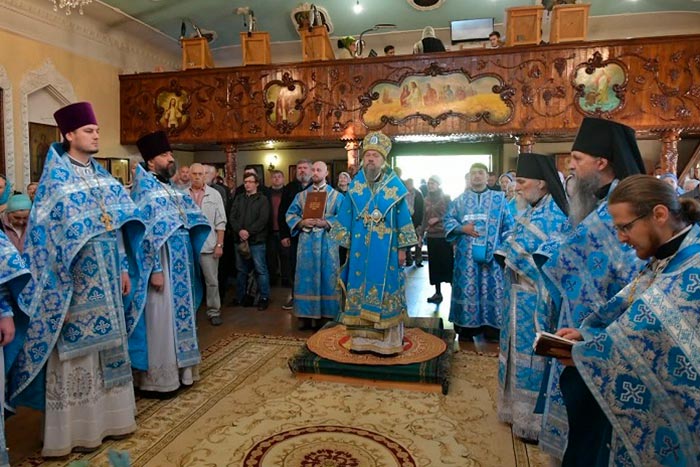
Patronal Feast Day at the Church of the Intercession in Almaty
More details




 Main
Main


Login or register, to write a comment!
Your comment has been successfully added and is currently being reviewed by the site administration